




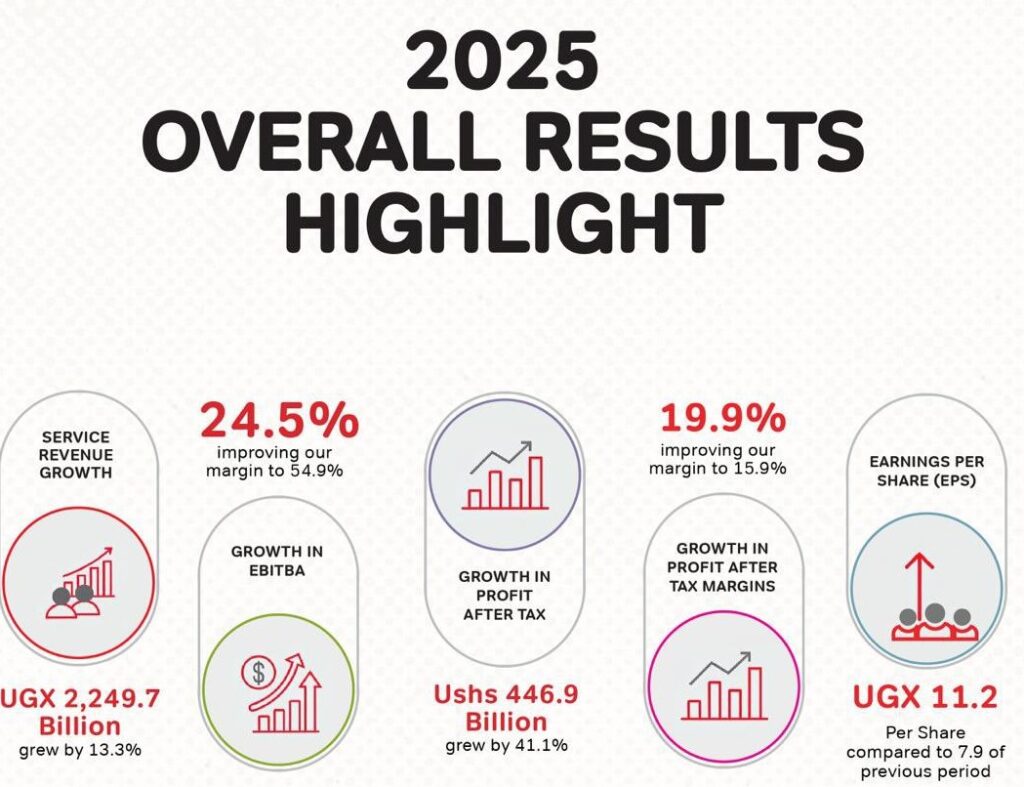
Airtel Uganda Limited has posted strong double-digit growth for the year ended December 31, 2025, with revenue rising 13.3 percent to UGX 2.25 trillion, driven by surging demand for data services and sustained network investment.
According to the company’s final results, total customers grew 13.9 percent to 19.2 million, while data subscribers rose 19.6 percent to 8.7 million. Data usage per customer increased 14.8 percent to 6.26 gigabytes, supported by smartphone penetration climbing to 43.5 percent.
Data revenue surged 22.4 percent to UGX 1.1 trillion, overtaking voice as the largest contributor to total revenue, underscoring the company’s transition from a traditional telecom operator to a data-led digital services provider. Overall average revenue per user declined 2.1 percent year-on-year, largely due to a cut in interconnect rates from UGX 45 to UGX 26 implemented in September 2024, which weighed on voice earnings.
EBITDA rose 24.5 percent to UGX 1.24 trillion, with margins expanding to 54.9 percent from 50 percent a year earlier, reflecting operational efficiencies and disciplined cost management. Profit after tax jumped 41.1 percent to UGX 446.9 billion, lifting profit margins to 19.9 percent despite higher finance costs linked to network expansion and extended tower lease agreements.
Basic earnings per share increased to UGX 11.2 from UGX 7.9 in the prior year. The board declared a final dividend of UGX 3.55 per share, bringing total dividends for the year to UGX 11.15 per share, a 41.6 percent increase consistent with its progressive dividend policy.
Capital expenditure rose 3.3 percent to UGX 252.5 billion, funding the rollout of 258 new 4G sites, 164 additional 5G sites and 1,600 kilometres of fibre. As of year-end, all sites were 4G-enabled, with 364 5G sites operational in major towns including Kampala, Gulu and Mbarara.
Managing Director Soumendra Sahu attributed the performance to focused execution, improved customer experience and supportive macroeconomic conditions, including GDP growth of about 4.8 percent and easing inflation.
Looking ahead, the company plans to deepen broadband adoption, expand enterprise services under its Network-as-a-Service offering and pursue satellite partnerships, subject to regulatory approval, to extend coverage and accelerate digital inclusion.