



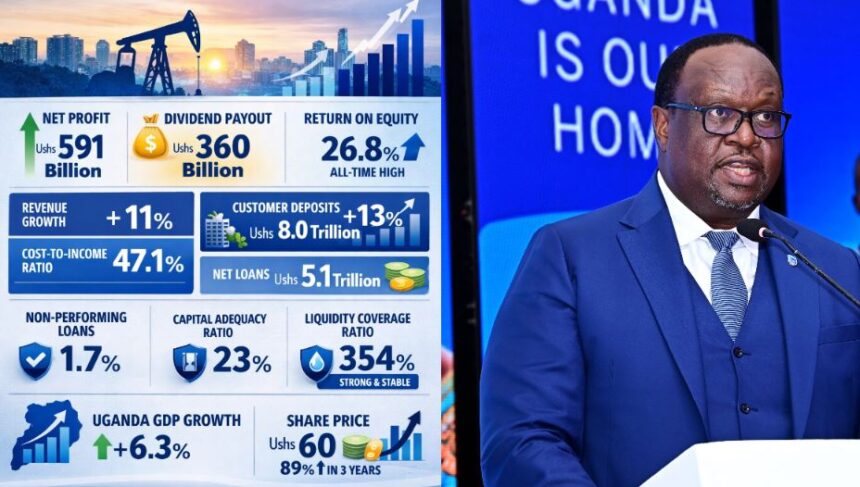
Stanbic Uganda Holdings Limited has announced a dividend payout of Ushs 360 billion to shareholders following a strong financial performance for the year ended December 31, 2025, underpinned by robust earnings growth, operational efficiency, and a resilient balance sheet.
The Group reported a net profit of Ushs 591 billion, representing a 23.6 percent increase from Ushs 478 billion posted in 2024. This growth was driven by an 11 percent rise in revenue and improved cost management, with the cost-to-income ratio narrowing to 47.1 percent.
Return on equity rose to 26.8 percent, significantly above the Group’s 20 percent benchmark, highlighting its ability to generate strong shareholder returns. Over a three-year period, the company’s share price has climbed 89 percent, closing at Ushs 60 at the end of 2025, reflecting sustained investor confidence.
Chief Executive Francis Karuhanga, who is concluding his tenure, said the results underscore the strength of the Group’s strategy and long-term focus on value creation. “Our robust earnings and strong return on equity reflect the resilience of our franchise and our unwavering commitment to delivering shareholder value,” he said.
The Group’s performance was largely anchored by its banking subsidiary, Stanbic Bank Uganda, which recorded strong growth in both deposits and lending. Customer deposits increased by 13 percent to Ushs 8.0 trillion, while net loans and advances grew by 16.4 percent to Ushs 5.1 trillion.
In his first year as Chief Executive of the bank, Mumba Kalifungwa attributed the performance to improved operational efficiency and growing customer trust. “We have built strong momentum and remain confident in sustaining this trajectory,” he said.
The results were supported by a favourable macroeconomic environment, with Uganda’s economy expanding by 6.3 percent in 2025, alongside stable inflation and a strengthening shilling.
Chief Financial Officer Ronald Makata said the Group maintained strong capital and liquidity positions, with a capital adequacy ratio of 23 percent and a liquidity coverage ratio of 354 percent, well above regulatory thresholds. Asset quality remained sound, with non-performing loans at 1.7 percent.
Analysis: Strong payout signals maturity—but raises reinvestment questions
Stanbic’s Ushs 360 billion dividend signals more than just profitability—it reflects a bank that has reached a level of earnings maturity, where capital generation comfortably exceeds immediate reinvestment needs. For investors, this positions Stanbic as a high-yield, defensive stock within Uganda’s equities market, particularly attractive in a relatively low-inflation environment.
However, the scale of the payout also raises strategic questions. With Uganda entering a capital-intensive growth phase—driven by oil development, infrastructure expansion, and industrialisation—banks are expected to play a central financing role. A high dividend distribution could suggest limited near-term appetite for aggressive balance sheet expansion, or alternatively, confidence that future growth can be funded without retaining a larger share of earnings.
Stanbic’s loan growth of 16.4 percent provides some reassurance that the bank is still actively deploying capital into the economy. Yet this remains below the pace typically associated with frontier market credit booms, suggesting a continued emphasis on risk discipline over rapid expansion.
The Group’s exceptionally low non-performing loan ratio of 1.7 percent reinforces this cautious stance. While it underscores high asset quality, it also indicates a selective lending approach that may leave segments of the market—particularly SMEs—underserved unless complemented by targeted risk-sharing mechanisms.
From a macro perspective, Stanbic appears to be optimally positioned for Uganda’s next growth cycle. A strengthening shilling, moderating interest rates, and improving investor sentiment—particularly around the oil sector—create favourable conditions for credit expansion and fee-based income growth.
Equally significant is the leadership transition. The handover from Francis Karuhanga to Mumba Kalifungwa introduces a subtle strategic inflection point. While continuity is evident in the current performance, the coming years will test whether the new leadership leans toward more aggressive market capture or maintains the Group’s historically conservative, efficiency-driven model.
The key takeaway is this: Stanbic is no longer just a growth story—it is evolving into a capital-return story. The critical question now is whether it can balance shareholder payouts with the demands of financing Uganda’s next phase of economic transformation.