



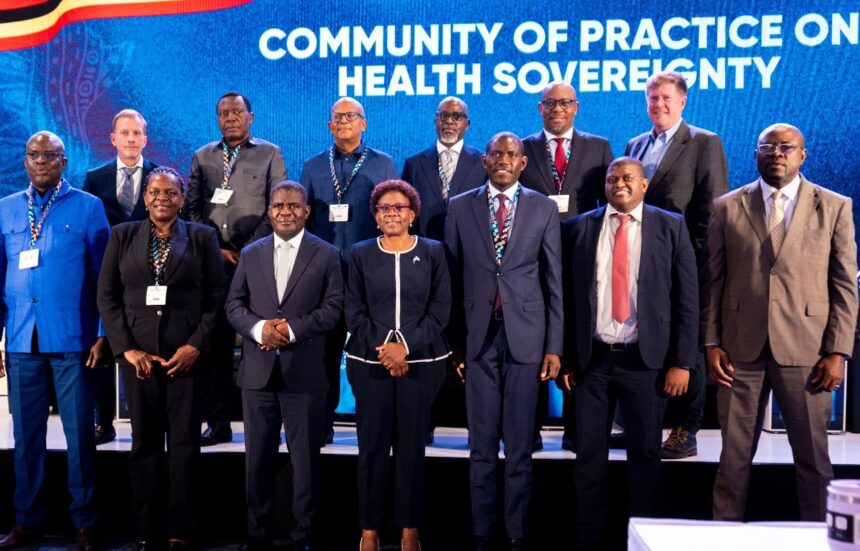
African countries are increasingly rethinking how they finance healthcare, with a strong push toward domestic resource mobilization and country-led systems taking centre stage at the inaugural Community of Practice on Health Sovereignty held in Kampala on March 25, 2026.
Speaking at the forum, Uganda’s Health Minister Dr. Ruth Aceng delivered a forceful call for African nations to take control of their health financing agendas, arguing that reliance on donor-driven priorities has undermined efficiency and long-term sustainability.
“Nobody will come from somewhere and teach you how to run your house. You have to run your house yourself,” Aceng said, emphasizing the urgency of African-led decision-making in health financing. She added that countries must determine their own priorities: “If we want to put the money in a certain area, so be it, because we know our challenges and we know what matters.”
Aceng criticized fragmented donor interventions, noting that externally funded vertical programs have led to duplication and inefficiency. “HIV was verticalized, TB was verticalized, malaria verticalized… just because of donor funds,” she said, warning that such approaches weaken national systems.
She further reiterated the need for continental unity in global health negotiations: “Without unity, we can’t make it… we are negotiating on our own, not as a bloc.”
Central to the discussions was the need to expand fiscal space for health. Director General of Health Services Dr. Charles Olaro stressed that countries must not only mobilize more domestic resources but also use existing funds more efficiently.
“We need to be able to see how to expand the fiscal space, but within the available fiscal space, how do we optimize and build efficiencies, and how do we integrate,” Olaro said.
He added that better outcomes are achievable even with constrained budgets: “With the same resources or even less resources, we should be able to build our countries and improve service delivery… and deliver better outcomes.”
Reinforcing the shift in thinking, Ntokozo Linton Mchunu, speaking on behalf of Nardos Bekele-Thomas, said the Community of Practice marked a departure from rhetoric to action-driven collaboration.
“This is not merely about dialogue, but about peer learning, implementation, action and commitment,” Mchunu said, noting that technical teams had translated discussions into “concrete 90-day action commitments.”
He emphasized that the outcomes were grounded in practical realities: “What comes before us today is not an abstract policy conversation, but a set of country-owned proposals for implementation grounded in real constraints, real opportunities, and real peer learning.”
Mchunu also reframed the role of health financing in Africa’s development, arguing that it must be seen as an economic driver rather than just a social obligation.
“Health is a direct economic investment. It drives manufacturing, infrastructure, logistics, science, technology, skills and innovation. It creates jobs and contributes to poverty reduction,” he said.
He questioned the continent’s continued dependence on imports and external systems, asking: “Is it okay to keep importing up to 97 percent of our medical products… is it okay that we are always at the back of the queue when it comes to access to vaccines and essential medicines?”
According to Mchunu, achieving health sovereignty requires a fundamental shift in approach, aligned with the African Union’s long-term development blueprint. “Sovereignty is about truly changing this paradigm… and seeking the welfare of our people as envisaged in Agenda 2063,” he said.
The meeting brought together ministries of finance and health from eight countries—Senegal, Kenya, Eswatini, Mozambique, Zambia, Tanzania, Botswana and South Africa—to co-create practical, country-led solutions. A key outcome was the adoption of a peer-driven model emphasizing accountability, measurable targets, and short-term action plans.
Participants aligned around the “Accra Reset” framework, which calls for countries to design and execute sovereign health financing strategies, strengthen regulatory systems, and build local manufacturing capacity.
While acknowledging progress in reducing mortality rates and expanding treatment access, officials warned that rising non-communicable diseases, climate risks, and shifting donor funding trends are placing additional strain on fragile systems.
The Community of Practice is expected to serve as a platform for continuous learning and reform, reinforcing a growing consensus that Africa’s health future will depend on domestic leadership, smarter financing, and regional solidarity.