



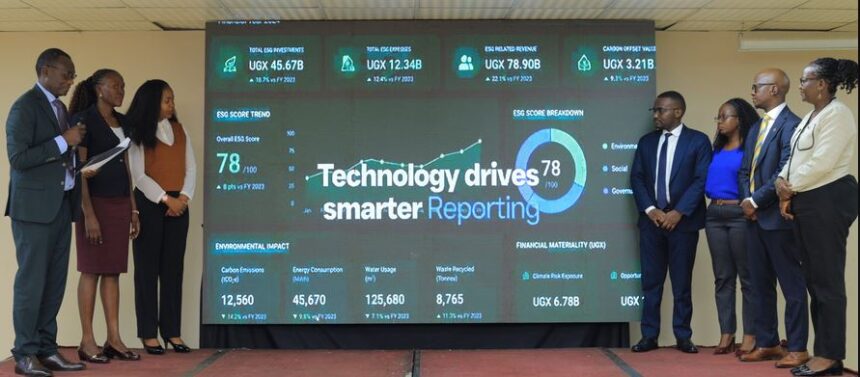
The Institute of Certified Public Accountants of Uganda (ICPAU) has launched the 16th edition of the Financial Reporting (FiRe) Awards, reaffirming the growing pressure on organisations to strengthen transparency, sustainability disclosures, and technology-driven reporting in an increasingly scrutinised corporate environment.
The awards, which will be held under the theme “Driving Sustainability Reporting through Technology and Innovation,” come at a time when global and local regulators are tightening expectations on environmental, social and governance (ESG) reporting, forcing companies to move beyond traditional profit-and-loss statements into broader impact-driven disclosures.
Stephen Ineget, Chairperson of the FiRe Awards Committee and Country Managing Partner at KPMG Uganda, said the 2026 edition will continue to push organisations toward more credible and comparable reporting standards, particularly as sustainability reporting frameworks become more complex and globally harmonised.
In his remarks during the launch, Ineget underscored that the awards—popularly known as “FiRe”—were established in 2011 to promote excellence not only in financial reporting, but also in governance, accountability, and corporate storytelling across sectors.
“FiRe means Financial Reporting Awards,” he said, adding with emphasis that the programme has evolved to include sustainability, management analysis, and integrated reporting as core pillars of evaluation. “We are now asking: what is the story behind the numbers? Why did you set up the business? What impact are you creating in society?”
ICPAU said the awards are increasingly aligned to international standards, including International Financial Reporting Standards (IFRS), International Public Sector Accounting Standards (IPSAS), and newer sustainability frameworks such as IFRS S1 and IFRS S2, which focus on sustainability and climate-related disclosures.
The push reflects a broader regulatory shift in Uganda’s corporate environment, where compliance is no longer limited to financial accuracy but extends to environmental impact, social responsibility, and governance transparency.
Regulators and capital market actors, including the Capital Markets Authority (CMA) and the Uganda Securities Exchange (USE), have been working to strengthen disclosure requirements as part of efforts to deepen investor confidence and attract long-term capital.
Ineget said one of the key objectives of the FiRe Awards is to assess whether organisations are presenting a “balanced and reasonable picture” of their performance, including economic outcomes, environmental footprint, and social contribution. He noted that comparability remains central, allowing Ugandan firms to benchmark against regional and global peers.
The awards also evaluate how effectively organisations communicate their performance to non-technical audiences, an area that has become increasingly important as companies face pressure to make financial reports more accessible to stakeholders beyond accountants and auditors.
According to ICPAU, categories for the 2026 edition remain unchanged, including excellence in financial reporting, corporate governance reporting, sustainability reporting, presentation and communication, most improved report, best listed entity, and integrated report of the year, which recognises gold, silver, and bronze performers.
The awards are open to a wide range of entities, including government ministries, agencies, universities, not-for-profit organisations, NGOs, and private sector companies such as banks, insurers, and regulatory bodies. ICPAU said it expects increased participation from the public sector this year, as government entities come under growing pressure to demonstrate transparency and efficiency in the use of public resources.
Submission of annual reports will open on June 1, 2026, and close on September 30, 2026. Organisations are required to submit consolidated annual reports, whether integrated or separately compiled, through ICPAU’s online portal or physical delivery to the institute. The submission platform is accessible via www.icpau.co.ug/fire-awards/fire-awards.
Beyond compliance and recognition, ICPAU argues that participation in the FiRe Awards has become a strategic advantage for organisations seeking to raise capital. Well-structured reports, officials say, improve investor confidence by clearly articulating governance structures, strategic direction, and long-term value creation.
Ineget pointed out that capital markets actors increasingly require multi-year financial data, often spanning three to four years, alongside clear articulation of strategy and sustainability outlooks.
In this context, high-quality reporting is becoming a de facto gateway to investment, particularly as Uganda seeks to deepen its capital markets and attract both domestic and foreign investors.
The emphasis on sustainability reporting also reflects shifting investor expectations globally, where environmental and social risks are now considered material to financial performance. Ugandan firms, particularly those seeking cross-border financing, are being pushed to align with global reporting standards to remain competitive.
ICPAU said the FiRe Awards also serve as a feedback mechanism, helping organisations identify gaps in disclosure and improve their reporting quality over time. This iterative improvement process has, over the years, contributed to raising the standard of corporate reporting in Uganda, particularly among listed firms and large public institutions.
As the 2026 edition is launched, ICPAU maintains that the ultimate goal is not only recognition, but the entrenchment of a culture of accountability and transparency.
In an economy where investor sentiment is increasingly shaped by data quality and governance credibility, the FiRe Awards have evolved into more than an annual ceremony—they are now a benchmark for corporate discipline in Uganda’s financial ecosystem.