



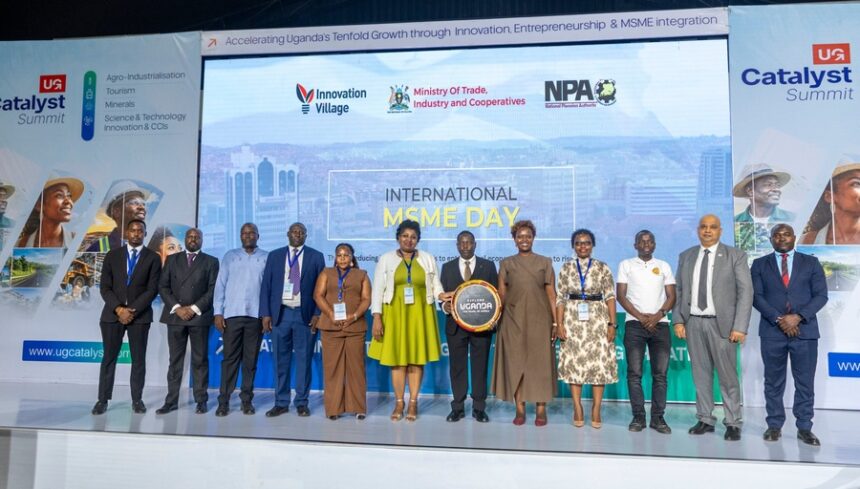
Uganda’s inaugural UG Catalyst Summit concluded with a strong call for greater collaboration between government, the private sector, investors and innovators to accelerate the country’s ambitious economic transformation agenda.
Held at MoTIV in Bugolobi under the theme “Catalyzing Action for Growth: Accelerating Uganda’s Tenfold Growth through Innovation and Entrepreneurship,” the two-day summit brought together policymakers, entrepreneurs, development partners, financial institutions and technology leaders to explore practical solutions for scaling businesses and creating jobs.
The discussions focused on positioning Micro, Small and Medium Enterprises (MSMEs) at the centre of Uganda’s strategy to grow its economy through industrialisation, innovation and value addition.
Speaking during the summit, Minister of Trade, Industry and Cooperatives Sanjay Tanna said formalising businesses would unlock greater opportunities for growth and competitiveness.
“Formalise to rise,” Tanna urged entrepreneurs, emphasising that formal businesses are better positioned to access finance, larger markets and government support programmes.
Participants agreed that reducing barriers to business registration, financing and market access will be critical if Uganda is to achieve its long-term development ambitions.
Permanent Secretary Lynette Bagonza described MSMEs as the backbone of Uganda’s economy, noting that they remain central to the country’s transformation agenda.
“MSMEs remain the primary vehicles through which innovation, entrepreneurship and industrial transformation will be realised,” she said.
The summit also highlighted the importance of innovation ecosystems in helping young entrepreneurs build scalable businesses.
Rita Ngenzi, Executive Director of Innovation Village Hub, called for stronger partnerships that connect innovators to capital, markets and mentorship, arguing that entrepreneurship should be treated as a national development strategy rather than an isolated private-sector activity.
Meanwhile, officials from the National Planning Authority stressed the need to move beyond policy discussions towards implementation. They said aligning enterprise development with Uganda’s Fourth National Development Plan (NDP IV) would enable businesses to contribute more directly to national economic growth.
Throughout the summit, delegates identified agro-industrialisation, tourism, mineral development, and science and technology innovation as the sectors with the greatest potential to drive enterprise growth and create employment.
The event concluded with renewed commitments from government agencies, development partners and private-sector leaders to strengthen collaboration, improve access to finance, support business formalisation and create an environment where Ugandan enterprises can compete regionally and globally.
Organisers said the summit is expected to become an annual platform for tracking progress on enterprise development and translating national economic ambitions into measurable action.