



By Brian Mugenyi
President Yoweri Museveni has urged Ugandans to rethink the growing pursuit of jobs abroad, arguing that the country’s abundant economic opportunities can generate greater prosperity than many overseas opportunities, as government rolled out a Shs2.06 billion reintegration package for 1,030 Ugandans repatriated from South Africa following xenophobic attacks.
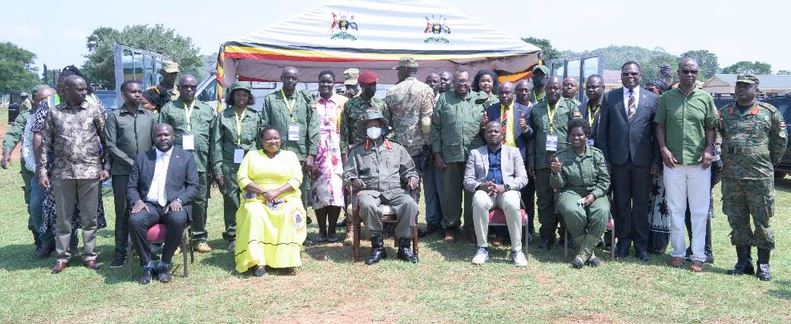
Speaking at the National Leadership Institute (NALI) in Kyankwanzi on Sunday, where the returnees completed a 15-day rehabilitation, counselling and patriotism programme, Museveni welcomed them home and challenged the belief that success lies outside Uganda.
“I welcome you from danger, and I thank God that you have returned safely,” the President said, while extending condolences to families that lost relatives during the attacks.
Using the Luganda proverb “Nantabuuliririrwa yasaabala gwa bbumba,” Museveni questioned why many Ugandans continue risking their lives abroad despite the country’s vast agricultural land, expanding industrial base and growing digital economy.
“Why would Ugandans leave such a beautiful country to go roaming around looking for jobs elsewhere?” he asked.
The President argued that commercial agriculture, manufacturing, services, skilled trades and technology present enormous opportunities for wealth creation, blaming labour export agencies and misinformation for convincing many young people that prosperity exists only overseas.
To reinforce his message, Museveni highlighted several local success stories. He cited Richard Nyakana of Fort Portal, who reportedly earns more than Shs200 million annually from dairy farming and poultry on just 1.2 acres while employing up to 15 workers.
He also referenced Johnson Basangwa of Kamuli District, whose poultry enterprise generates nearly Shs20 million daily from egg sales, and Vicky Apio of Lira, who transformed a Shs907,000 Parish Development Model (PDM) loan into a thriving farming business.
According to the President, if Uganda’s estimated 40 million acres of arable land were fully commercialised, millions of jobs could be created domestically.
Beyond economic empowerment, Museveni addressed the xenophobic violence that forced the Ugandans to flee South Africa. He revealed that he had personally raised the matter with South African President Cyril Ramaphosa, warning that attacks on fellow Africans threaten regional integration and continental unity.
“If countries begin retaliating against one another, it will be dangerous for the entire continent,” he cautioned, while urging Ugandans not to target South African businesses operating in Uganda.
Government announced that each household head among the returnees would receive approximately Shs2 million to facilitate transport and resettlement. Museveni encouraged beneficiaries to tap into wealth creation initiatives such as the Parish Development Model, Emyooga and other government livelihood programmes to rebuild their lives.
Prime Minister Robinah Nabbanja described the evacuation as one of Uganda’s largest humanitarian rescue operations involving citizens abroad, confirming that Uganda Airlines repatriated all 1,030 Ugandans free of charge. She also disclosed that another 525 Ugandans stranded in Cambodia have appealed for government assistance to return home.
Acting State Minister for Foreign Affairs Haruna Kyeyune Kasolo confirmed that three Ugandans lost their lives during the attacks and commended the President for providing Shs10 million to each bereaved family.
He added that Uganda’s High Commission in Pretoria has registered more than 600 Ugandans who remain in South Africa and called for tighter regulation of labour externalisation agencies.
The rehabilitation programme, coordinated by the National Secretariat for Patriotism Corps, combined trauma counselling with practical support.
Of the 1,030 returnees, 738 were adults and 292 children. Four adults and six children required specialised treatment at Mulago National Referral Hospital, while mobile teams from the National Identification and Registration Authority issued 650 national identity cards and 239 National Identification Numbers to participants lacking documentation.
Representing the returnees, Felix Mugabi thanked the government for rescuing them and restoring hope, saying many had returned with valuable skills in construction, engineering, tailoring, information technology and real estate.
He appealed for financial support and the establishment of a national association of returnees to help them access government programmes and rebuild sustainable livelihoods.
The repatriation marks not only the end of a humanitarian rescue mission but also the beginning of a broader government effort to redirect Ugandans’ ambitions toward domestic enterprise, with Museveni insisting that the country’s greatest economic opportunities lie within its own borders.