



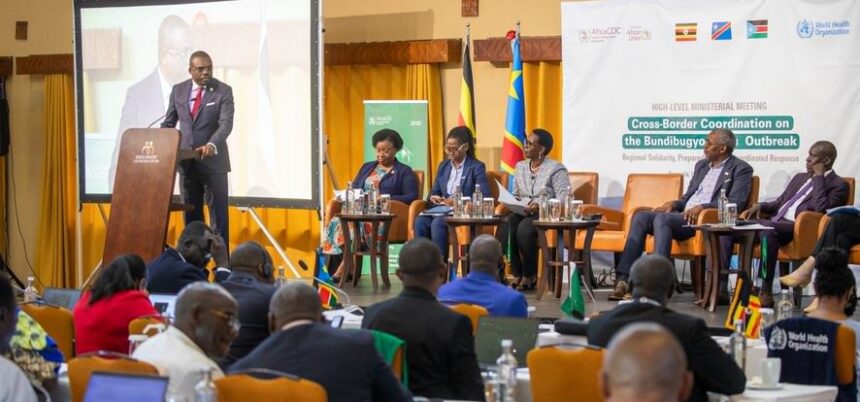
Health leaders from across Africa have warned that the Ebola outbreak spreading in the Democratic Republic of Congo (DRC) and Uganda risks escalating into a wider continental crisis unless governments and partners move with greater urgency, funding and coordination.
The warning came during an emergency press briefing convened by the Africa Centres for Disease Control and Prevention (Africa CDC) in Kampala on May 23, where senior officials outlined the growing scale of the outbreak and appealed for immediate international and African support.
Speaking during the meeting, Uganda’s Permanent Secretary at the Ministry of Health, Diana Atwiine said the response faces enormous operational challenges ranging from insecurity in eastern Congo to language barriers and cross-border movement.
“As we discuss today, I want you to take note of the magnitude of the problem at hand,” Atwiine said. “Where we are going to be operating, there are so many other factors. We have insecurity, we have cross-border issues, even language barriers. Congo speaks French, Uganda speaks English, yet we must work together.”
She said the gathering in Kampala demonstrated a shared commitment among African governments and development partners to stop the outbreak before it spreads further.
“No country can be safe until all of us are safe,” Atwiine said. “If Uganda and DRC are not safe, then the region, the continent and the globe are not safe.”
The briefing brought together health ministers, development agencies, humanitarian organisations and international partners as cases linked to the deadly outbreak continue to rise.
Africa CDC Director General Jean Kaseya described the situation as one of the most serious Ebola emergencies the continent has faced in recent years.
“This is a serious outbreak,” Kaseya said. “It is the first time we are seeing Bundibugyo Ebola with more than 750 suspected cases and more than 175 deaths. We are still at the peak of this outbreak.”
He warned that without rapid intervention, additional countries could soon report infections.
“If we don’t act today, this outbreak can become out of control very quickly,” he said. “We don’t want to see a third country, a fourth country infected. We don’t want to see other continents infected.”
Kaseya revealed that Africa CDC and partners are seeking at least $314 million to finance the emergency response, with fundraising efforts already underway alongside the World Health Organization, UNICEF and UNFPA.
He noted that women account for roughly 60% of those affected, making gender-focused interventions critical.
The Africa CDC chief also praised Uganda and DRC for acting transparently and quickly after detecting cases.
“What is critical during an outbreak is transparency,” he said. “Without transparency, we will not know what is happening.”
Kaseya commended President Yoweri Museveni for rapidly convening a national task force and reallocating government resources toward the response. He also applauded DRC President Félix Tshisekedi for committing an initial $20 million.
The Africa CDC Director General insisted African countries must contribute domestic resources before relying heavily on donors.
“Sovereignty starts with governments taking responsibility for the lives of their people,” he said. “Africa must lead this response.”
He disclosed that African business leaders including Aliko Dangote, Benedict Oramah, George Elombi and Tony Elumelu had pledged support for the emergency effort.
Kaseya also raised concerns about accountability in outbreak financing, questioning reports that nearly $350 million had already been mobilised despite limited improvements on the ground in affected areas such as Ituri Province in eastern DRC.
“We need transparency and accountability,” he said. “It is not time again in Africa for lack of transparency or fraud.”
Africa CDC has now activated a regional Incident Management Support Team headquartered in Kampala to coordinate operations across Uganda, DRC and neighbouring high-risk countries including Rwanda and Burundi.
The emergency operation follows the declaration of Ebola as a Public Health Emergency of International Concern by World Health Organization Director-General Tedros Adhanom Ghebreyesus, with Africa CDC issuing its own continental emergency declaration shortly afterwards.
Officials say the coming weeks will be critical in determining whether the outbreak can be contained before spreading deeper across the region and beyond.