



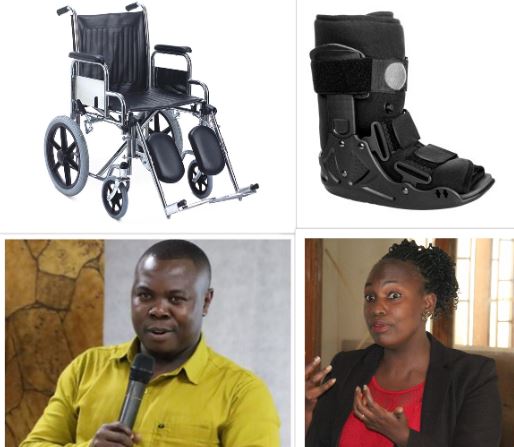
“Persons with disabilities comprise 13.2 percent of the total population, and this is a big number that needs to be prioritized by the fourth estate when it comes to reporting on their issues.”
Concerns have been raised over the deteriorating state of orthopedic and rehabilitation services in Uganda, with disability rights advocates warning that many persons with disabilities continue to suffer due to under-equipped facilities, limited assistive devices and inadequate government support.
Speaking during a disability inclusion and awareness engagement with journalists and editors, David Nangose from the National Union of Disabled Persons of Uganda (NUDIPU) said orthopedic workshops in several referral hospitals remain in poor condition despite the growing need for rehabilitation services across the country.
“The existing orthopedic workshops are in a dilapidated state. Mulago is relatively better, but it is still under-equipped and lacks enough human resources,” Nangose said.
He explained that many facilities lack the equipment and skilled personnel needed to produce essential assistive devices such as artificial limbs, calipers, walking sticks and other rehabilitation appliances used by persons with disabilities.
Nangose called on government to invest more resources into orthopedic rehabilitation centers and ensure that hospitals are fully equipped to support persons with disabilities seeking treatment and mobility assistance.
Beyond healthcare, he said persons with disabilities continue to face widespread exclusion in employment, education and access to public services.
According to Nangose, Uganda has not yet operationalized disability employment quotas under Section 9(6) of the Persons with Disabilities Act, making it unclear how many jobs in public institutions should be reserved for persons with disabilities.
“When ministries, agencies or local governments advertise jobs, it is not clear how many opportunities should be allocated to persons with disabilities,” he said.
He further appealed for stronger enforcement of accessibility standards in both public and private infrastructure, arguing that many buildings remain inaccessible despite existing legal requirements.
Nangose also urged government to locally manufacture sunscreen lotions for persons with albinism, saying reliance on imported products has made them expensive and difficult to access.
He added that disability inclusion in government planning and budgeting remains low, with only about 35 percent of ministries, departments and agencies integrating disability-sensitive planning into their programs.
At the same engagement, Doreen Sampa, a Human Rights and Advocacy Officer at the Uganda Media Women’s Association (UMWA), raised concern over increasing cases of gender-based violence affecting women and girls with disabilities.
She said many survivors face double discrimination because of both their gender and disability status, yet their experiences rarely receive adequate media coverage.
“When gender-based violence happens, the woman is affected more. But the woman with disability is actually affected twice. She is discriminated against because of her disability and also suffers the violence,” Doreen said.
She also highlighted persistent barriers in education, health care and access to justice for persons with disabilities.
“Sometimes the students are there, but there are few sign language interpreters. The braille machines are not there,” she noted.
Doreen added that deaf persons often struggle to access healthcare and justice because many hospitals, police stations and courts lack sign language interpreters.
“You are at the police station, but there is nobody who is able to interpret for you,” she said.
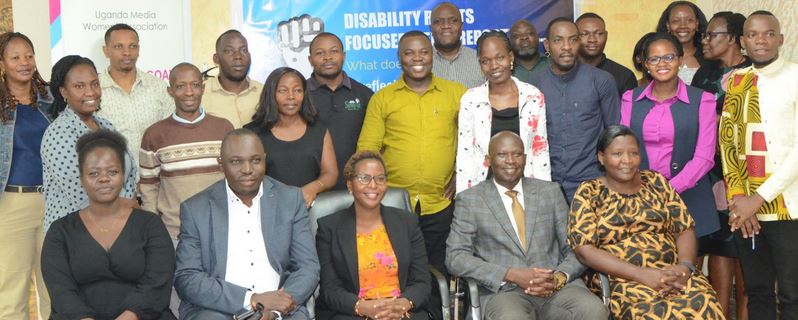
The concerns were raised during a disability inclusion and awareness training organized by NUDIPU under its Capacity Building Program Office of Human Rights.
The training brought together journalists and editors from different media houses to strengthen disability-sensitive reporting and improve media coverage of issues affecting persons with disabilities in Uganda.
“The more these issues come out, the more the duty bearers are called to act,” Doreen said.