



President Donald Trump has announced the US will double its current tariff rate on steel and aluminium imports from 25% to 50%, starting on Wednesday.
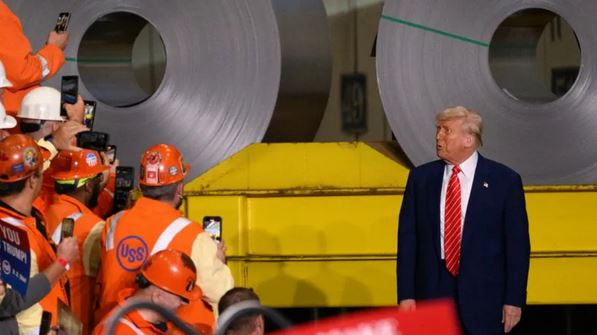
Speaking at a rally in Pittsburgh, Pennsylvania on Friday, Trump said the move would help boost the local steel industry and national supply, while reducing reliance on China.
Trump also said that $14bn would be invested in the area’s steel production through a partnership between US Steel and Japan’s Nippon Steel, though he later told reporters he had yet to see or approve the final deal.
The announcement is the latest turn in Trump’s approach to tariffs since re-entering office in January.
“There will be no layoffs and no outsourcing whatsoever, and every US steelworker will soon receive a well deserved $5,000 bonus,” Trump told the crowd, filled with steelworkers, to raucous applause.
One of the major concerns from steelworkers about the US-Japan trade deal was how Japan would honour the workers’ union contract which regulates pay and hiring.
Trump began his remarks by saying he had “saved” US Steel, America’s biggest steel manufacturer, located in Pittsburgh, with the 25% tariffs he implemented during his first term as president in 2018.
Both sales and profits at US Steel have been falling in recent years.
Trump touted the increase to 50% as a way to ensure US Steel’s survival.
“At 50%, they can no longer get over the fence,” he said. “We are once again going to put Pennsylvania steel into the backbone of America, like never before.”
US steel manufacturing has been declining in recent years, and China, India and Japan have pulled ahead as the world’s top producers. Roughly a quarter of all steel used in the US is imported, and the country’s reliance on Mexican and Canadian steel has angered Trump.
“It is a good day for steelworkers,” JoJo Burgess, a member of the local United Steelworkers union who was at Trump’s rally, told the BBC.
Mr Burgess, who is also the city mayor of nearby Washington, Pennsylvania, expressed optimism over the reported details of the partnership with Nippon Steel, saying he hoped it would help breed a new generation of steel workers in the area.
He recalled “making a lot of money” in the years after Trump instituted steel tariffs in his first term.
Source:BBC