



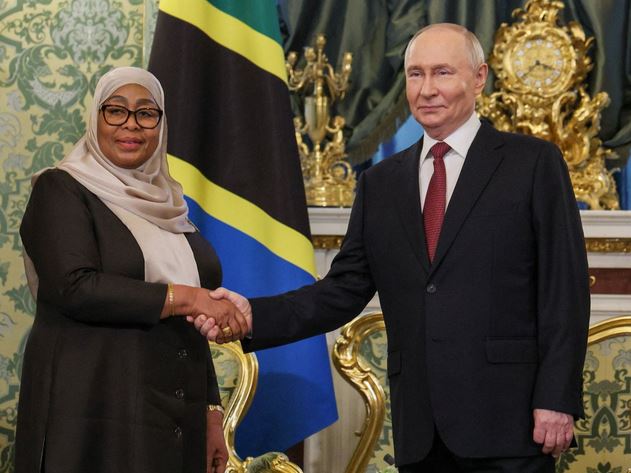
A complex geopolitical balancing act is unfolding between Washington and Dodoma. At the center of this friction is Tanzania’s vast wealth of critical minerals and rare earth elements—resources that have become the frontline of a modern economic cold war.
As the West scrambles to secure supply chains for technologies like electric vehicles and defence systems, President Samia Suluhu Hassan’s government finds itself holding a powerful hand, even as its internal human rights record draws intense scrutiny from Capitol Hill.
A Heated Senate Hearing
This delicate dynamic came to a head during a rocky U.S. Senate Foreign Relations Committee confirmation hearing. William Trachman, Washington’s ambassadorial nominee to Tanzania, explicitly termed the East African nation as a country of “immense strategic importance.”.
However, Trachman’s path was anything but smooth. Senators lambasted the nominee, accusing him of soft-pedaling on President Samia’s administration following the fallout of the October 2025 elections.
A subsequent commission of inquiry revealed that approximately 500 people lost their lives in post-election violence—a statistic that has severely strained Tanzania’s image in the West.
Trachman conceded that the violence “raised serious concerns about Tanzania’s trajectory as a reliable partner,” promising that the situation would not be “swept under the rug” during an ongoing bilateral review.
Yet, the strategic undercurrents of the hearing were undeniable. Despite democratic backsliding, the U.S. finds it difficult to distance itself from a nation holding massive deposits of nickel, graphite, and rare earth minerals.
The Beijing-Moscow Factor
What makes Tanzania so critical to Washington is the looming shadow of the Beijing-Moscow axis. Tanzania has a long history of alignment with the People’s Republic of China, and Beijing is moving quickly to solidify its grip on East African logistics.
A prime example is China’s heavy investment in rehabilitating the TAZARA railway, which links Zambia’s Copperbelt directly to the port of Dar es Salaam.
This infrastructure push places China in direct competition with the Lobito Corridor—a flagship transit route backed heavily by the United States and the European Union designed to move minerals west through Angola.
Even if the West succeeds in building alternative infrastructure, a glaring vulnerability remains: the vast majority of processing and refining facilities for critical minerals reside in China.
This leaves Washington in a position where it must actively court countries like Tanzania to ensure American enterprises can compete on a predictable, transparent legal playing field.
Dodoma’s Two-track Strategy
Recognising its leverage, President Samia’s government has quietly deployed a two-track diplomatic strategy.
On one hand, Dodoma has been publicly dismissive of the threat of losing Western funding over human rights concerns. On the other hand, the administration has spent millions of dollars on influential U.S. lobbyists to protect its critical minerals pipeline from potential congressional sanctions.
By leaning into Trachman’s impending arrival, Samia’s government hopes to pivot the bilateral conversation away from democratic accountability and squarely toward commercial and security partnerships along the Indian Ocean coast.
For Washington, the challenge is having to navigate a relationship where ignoring human rights compromises American values, but pushing too hard risks handing a mineral-rich prize entirely to its geopolitical rivals.