



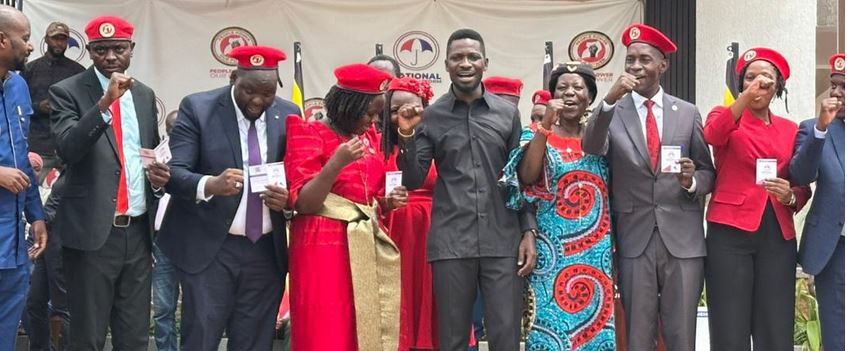
Uganda’s political terrain is once again shifting dramatically, as a fresh wave of defections in Parliament alters the balance of power among major political parties. The recent realignments—some expected, others surprising—have created both strategic opportunities and potential crises for Uganda’s leading political entities.
A closer analysis of the changes suggests that the ruling National Resistance Movement (NRM) and the opposition National Unity Platform (NUP) have emerged as the biggest net gainers, while the Democratic Party (DP) and Forum for Democratic Change (FDC) are grappling with serious setbacks.
Meanwhile, the newly launched Democratic Front (DF), spearheaded by embattled former Leader of Opposition Mathias Mpuuga, has made an attention-grabbing debut with four MPs crossing to its banner.
The Winners
NRM: The Silent Strategist
The NRM, led by President Yoweri Museveni, continues to flex its political muscle, gaining four MPs—Twaha Kagabo, Anthony Akol, Moses Okot, and Ojara Mapenduzi—without losing a single legislator. While these gains are not massive in number, their significance lies in NRM’s continued ability to draw opposition MPs into its ranks, reinforcing the party’s dominance in Parliament. With no internal hemorrhaging, the NRM’s quiet growth reaffirms its status as the most stable political formation in Uganda.
NUP: Resilience Amidst Turbulence
Despite high-profile defections, NUP has surprisingly emerged with a net gain of three MPs. The party lost four influential figures: Twaha Kagabo, Mathias Mpuuga, Abed Bwanika, and Juliet Kakande—all with considerable grassroots networks. Yet, it successfully attracted seven new MPs, including Theodore Ssekikubo Lutamaguzi, David Isabirye, Patrick Nsanja, Joan Namutaawe, John Lukwago Mpalanyi, Fortunate Rose Nantongo, and Timothy Batuwa Lusala.
Notably, three MPs from the Busoga sub-region have recently joined NUP—a signal that the party is consolidating support in Eastern Uganda. This development could hint at NUP’s growing regional traction beyond its Buganda heartland.
Democratic Front (DF): A Promising Debut
Still in its infancy, DF—formed by Mathias Mpuuga—has made an impressive entry into the national arena. It has attracted four MPs: Mpuuga himself, Abed Bwanika, Michael Kakembo, and Juliet Kakande. The party’s short-term viability will depend on whether more MPs from NUP or DP join its ranks in the coming weeks, as some insiders have hinted. If that happens, DF could reshape opposition dynamics ahead of the 2026 elections.
The Losers
FDC: A Party in Freefall?
Once Uganda’s dominant opposition force, FDC appears to be hemorrhaging support. It lost four MPs—Anthony Akol and Moses Okot to the NRM, and David Isabirye and Timothy Batuwa to NUP. The party gained none in return. With these losses and persistent internal wrangling, FDC’s path to relevance in the next parliament looks increasingly uncertain.
DP: Shrinking Influence
The Democratic Party, Uganda’s oldest political entity, is in decline. It failed to gain any MPs and lost three key legislators—Lutamaguzi, Fortunate Rose Nantongo, and John Lukwago Mpalanyi—to NUP. DP’s support base has been steadily eroded over recent election cycles, and unless it pulls a strategic surprise, it risks falling below the 10-MP threshold in the next parliament.
What’s at Stake
This realignment highlights a crucial reality: Uganda’s political center is shifting, and the next general election in 2026 may be defined by how parties consolidate their base and attract disillusioned independents or defectors.
While NRM continues to expand through quiet absorption, NUP’s resilience in the face of defections reflects a maturing party machinery. The emergence of DF adds another layer of complexity to opposition politics, especially if it manages to attract undecided MPs. Conversely, FDC and DP must urgently rethink their strategies or risk irrelevance in a rapidly polarizing political environment.
As party loyalties realign, the battle for the soul of Uganda’s opposition—and by extension, its democratic future—has just entered a decisive phase.