



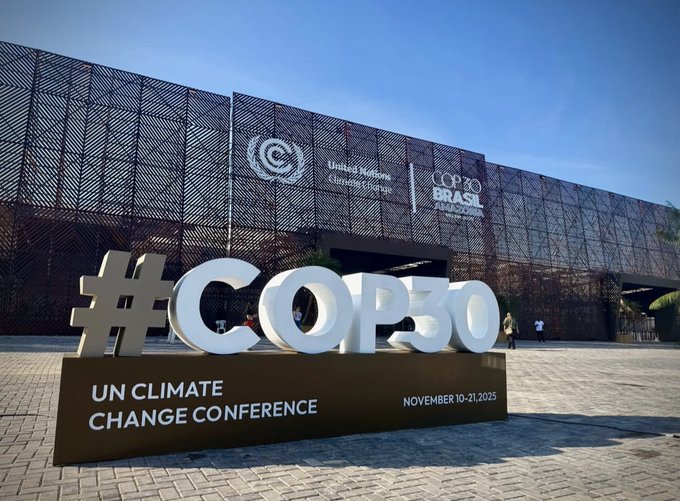
Africa used its Africa Day celebrations at COP30 in Belém to make a decisive call for a transformative climate finance system that finally delivers for the continent’s people, economies, and ecosystems.
Marked under the theme “At the Forefront of Climate Action: Sustainable Financing for Inclusive and Resilient Green Growth,” the event drew ministers, development partners, and senior officials from the African Union Commission (AUC), UNECA, AfDB, Afreximbank, civil society, and youth networks.
Ten years after the Paris Agreement, African leaders warned that climate pledges remain dangerously out of step with global warming realities.
Africa, which contributes less than four percent of global emissions but hosts 20 percent of the world’s carbon sinks, continues to receive under 10 percent of adaptation finance and only three percent of total climate funding.
AUC Commissioner for Agriculture, Rural Development, Blue Economy and Sustainable Environment, H.E. Moses Vilakati, reaffirmed Africa’s unified position on climate justice.
“Africa speaks with one voice — bold, united, and leading on climate justice,” he said. “We are not passive recipients of the global transition but active architects of fair, inclusive, and African-led climate solutions.”
Discussions highlighted the need for innovative and equitable financing to accelerate green industrialisation. Leaders stressed that Africa’s future lies in leveraging its natural resource wealth for value addition — from processing critical minerals to scaling renewable energy and local manufacturing.
Dr Kevin Kariuki, AfDB Vice President for Power, Energy, Climate and Green Growth, underscored the Bank’s sharpened strategic direction.
“We are taking decisive steps to close Africa’s sustainable financing gap and strengthen adaptive capacity through innovation, partnerships, and financial leadership,” he said.
Africa holds vast untapped potential in carbon markets, estimated to generate up to $100 billion annually and five million green jobs by 2030 with the right governance. Yet the continent currently captures less than one percent of global carbon revenue.
Speakers reiterated the urgency of reforming the global financing architecture. UNECA’s Cosmas Milton Ochieng warned that a predictable, transparent, and equitable system “is a prerequisite for survival.”
With more than $350 billion in domestic sovereign and pension funds, leaders called for mobilising both internal and external resources to advance Agenda 2063.
Africa Day closed with a strong demand for fair carbon pricing, direct access to finance, and full implementation of the $300 billion climate finance pledge for Africa — commitments that remain unmet after COP29 in Baku.