



Nigeria has crossed a historic threshold—quietly but decisively. For the first time in decades, Africa’s largest oil producer is exporting more petrol than it imports, signaling a dramatic reversal of a long-standing economic paradox.
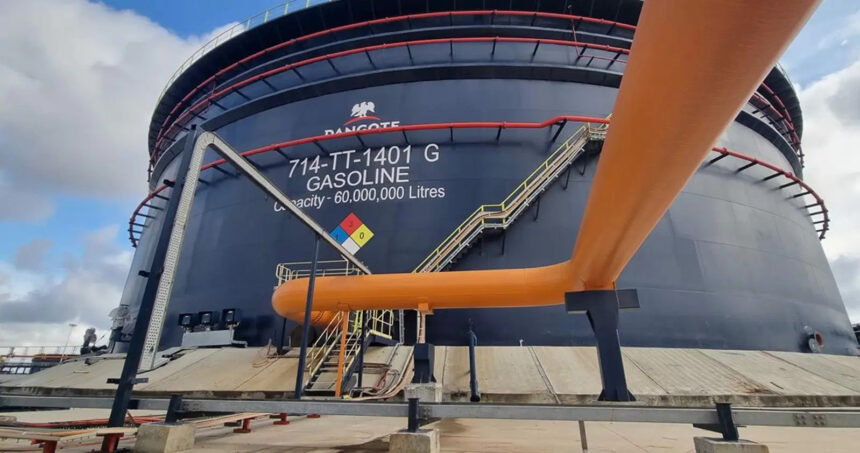
The shift, recorded in March 2026, has been powered almost entirely by the rise of the Dangote Petroleum Refinery, a mega-project that is rapidly redefining Nigeria’s downstream oil sector.
According to market intelligence firm Kpler, the country exported about 44,000 barrels per day (bpd) of petrol during the month, slightly surpassing imports and leaving a net surplus of roughly 3,000 bpd.
For a country that has spent decades importing refined fuel despite vast crude reserves, the milestone is both symbolic and economically significant.
For years, Nigeria’s reliance on fuel imports drained foreign exchange reserves and left the economy exposed to global supply shocks. State-owned refineries underperformed, forcing the country to depend heavily on external suppliers. That dynamic is now shifting, and fast.
Crude supply to the Dangote refinery climbed to around 565,000 bpd in March—one of its highest levels since operations began in late 2023—while petrol imports dropped sharply to about 41,000 bpd, the lowest level on record. The figures point to a clear trend: domestic refining is steadily replacing imports.
But the impact extends beyond Nigeria’s borders.
In a move that signals growing regional ambition, the refinery recently shipped a 317,000-barrel cargo of petrol to Mozambique—its first export to East Africa—with another shipment expected soon. This development could reshape fuel supply chains across the continent, as countries traditionally reliant on Middle Eastern imports begin to diversify their sources.
At the center of this transformation is billionaire industrialist Aliko Dangote, whose refinery is now emerging as a strategic asset not just for Nigeria, but for Africa’s broader energy market.
Economically, the benefits could be far-reaching. Exporting petrol is expected to boost foreign exchange earnings while easing demand for dollars previously used for imports—a key factor behind pressure on the naira in recent years. It also strengthens energy security by anchoring supply within domestic capacity.
Yet, the shift is not without its implications. Nigeria’s entry into the export market could intensify competition globally, particularly in Europe where petrol supply is already abundant. At home, sustaining refinery output and ensuring consistent crude supply will be critical.
There is also a bigger structural story unfolding. Nigeria is finally beginning to move from exporting crude and importing refined products to processing its own resources—a policy ambition that has eluded successive governments for decades.
For now, Nigeria’s fuel story is being rewritten—and the rest of Africa is paying attention.
With plans underway to potentially list the refinery across multiple African stock exchanges, the ripple effects could extend into capital markets, deepening regional investment flows.