



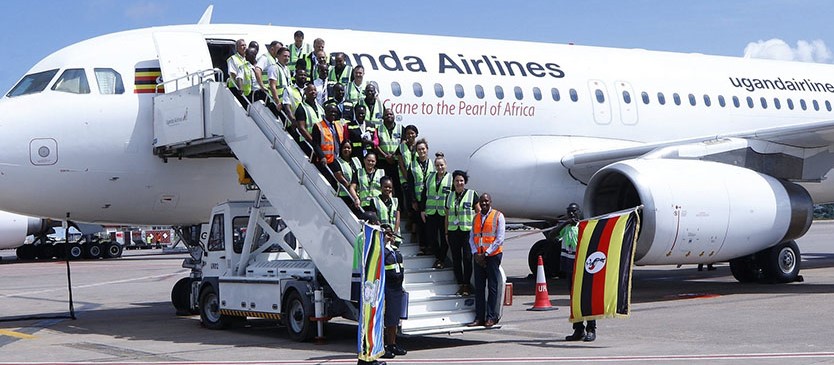
Uganda’s national carrier has quietly turned to a regional rival to keep its most strategic routes alive, highlighting the fragile economics behind long-haul aviation in emerging markets.
Uganda Airlines confirmed this week that it has secured a Boeing 787-8 Dreamliner from Ethiopian Airlines under an Aircraft, Crew, Maintenance and Insurance (ACMI) agreement to restore suspended intercontinental services.
The leased aircraft will allow the airline to resume flights from Entebbe to London and Mumbai starting March 7, after a technical issue grounded one of the carrier’s wide-body aircraft and triggered a temporary halt in long-haul operations.
But behind the swift operational fix lies a deeper set of questions about fleet redundancy, financial exposure, and the operational resilience of a state-owned airline that has invested heavily in modern aircraft but operates with a small long-haul fleet.
A single Aircraft Problem
The disruption began in late February when one of Uganda Airlines’ Airbus A330-800neo aircraft developed a technical fault requiring extended inspection.
Because the airline operates only two A330-800neos, the issue effectively reduced its long-haul capacity by half. When the second aircraft required precautionary checks, the airline had little operational buffer.
Aviation analysts say this vulnerability is typical for young carriers with limited fleet depth.
“When your long-haul network depends on two aircraft, any technical issue immediately becomes a commercial crisis,” said one East African aviation consultant who tracks fleet utilization in the region.
The Ethiopian Lifeline.
The decision to lease from Ethiopian Airlines was not accidental.
Ethiopian Airlines operates Africa’s largest fleet of Boeing 787-8 Dreamliner jets and is widely regarded as the continent’s most profitable airline.
Under the ACMI arrangement, Ethiopian provides the aircraft, crew, maintenance and insurance while Uganda Airlines handles ticket sales and route operations.
While such leases are common in aviation, they can be expensive.
Industry estimates suggest that leasing a Dreamliner under ACMI can cost between $7,000 and $12,000 per flight hour, depending on the contract terms and utilization levels.
For a long-haul route such as Entebbe to London—typically an eight-hour flight—the operational cost can quickly climb, potentially eating into already thin margins.
Strategic Routes at Stake
The routes being protected are among the airline’s most commercially important.
The Entebbe–London service, launched in 2023 to Gatwick Airport, restored direct air connectivity between Uganda and the United Kingdom for the first time in nearly a decade.
Meanwhile, the Entebbe–Mumbai route connects Uganda to one of Asia’s largest medical tourism and trading hubs.
Indian hospitals attract hundreds of Ugandan patients annually, while traders regularly travel between Kampala and Mumbai for pharmaceuticals, textiles and machinery.
Losing either route—even temporarily—would risk ceding market share to foreign carriers operating through hubs such as Addis Ababa, Nairobi or Doha.
The Bigger Question: Sustainability
The incident has revived debate within aviation circles about whether Uganda Airlines’ long-haul ambitions are moving faster than its operational capacity.
The airline has invested heavily in modern aircraft—including A330neos widely praised for fuel efficiency—but critics argue the fleet remains too small to provide operational resilience.
“There is nothing wrong with leasing aircraft in emergencies,” said an aviation finance analyst in Nairobi. “The real issue is whether the airline has built enough fleet redundancy to avoid disruptions.”
Uganda Airlines says passenger confidence remains its priority and has offered free ticket revalidation to travelers affected by the suspension.
Flights to London and Mumbai are now scheduled to resume, while services to Dubai remain under review as technical inspections continue.
For now, the emergency Dreamliner lease has bought the airline time.