




As Uganda approaches its 4th cycle of the Universal Periodic Review (UPR) under the United Nations, a critical debate is erupting over the country’s actual human rights progress.
While the state has successfully passed landmark legislation over past cycles, civil society groups warn that a severe “implementation deficit” is leaving vulnerable populations unprotected.
In an exclusive interview with Highflyer Report’s Edwin Muhumuza, Lois Mwaniki Schmelzenbach, a Project Officer in the Health Justice Program at the East African Center for Human Rights (EACHRights), exposed the widening gap between international commitments and local reality.
The Shift to a Rights-Based Approach in Uganda
The Universal Periodic Review functions as a peer-review mechanism where the human rights record of every UN member state is evaluated every five years. Uganda’s tracking began during its first review in 2011. Going into this current cycle, Mwaniki highlights a massive paradigm shift in how sexual and reproductive health rights (SRHR) are evaluated.
“There is a major movement away from treating sexual reproductive health strictly as a public health resource delivery issue, and moving toward a rights-based approach,” Mwaniki explained. “Globally, it is no longer just about the government providing services. Governments must view recipients as individuals with inherent rights.”
This shift has fundamentally altered the nature of UN recommendations. While early cycles focused broadly on reducing maternal mortality, current peer-state expectations demand structured legal protections, comprehensive sexuality education, and systemic systems change.
Uganda’s Human Rights Progress vs. The Implementation Deficit
Statistically, peer recommendations targeting gender-based violence (GBV) in Uganda have surged by nearly 28% across previous cycles. In response, Uganda has successfully built a robust statutory framework, including;The Domestic Violence Act,The Prohibition of Female Genital Mutilation (FGM) Act, and the establishment of specialized GBV courts.
However, these legislative milestones are stalling on the ground due to deep structural roadblocks.
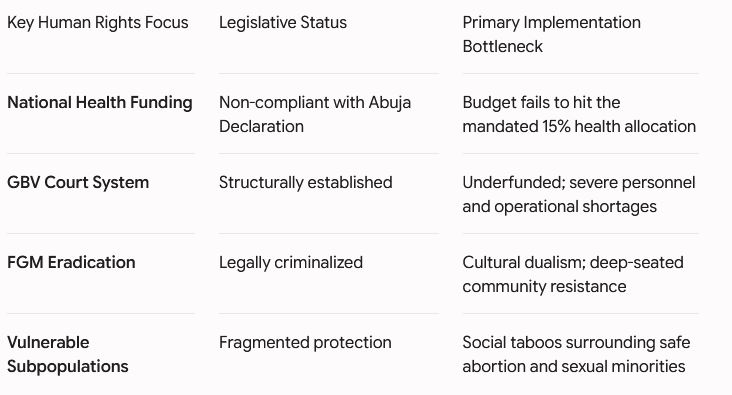
“We find that these legal instruments are firmly in place, but there is an execution deficit largely based on budget,” Mwaniki noted. “When no money is assigned to their realization, it hampers the extent to which existing laws can protect victims of these crimes.”
The Pandemic’s Toll on Youth and Demographic Realities
A major priority for civil society actors during this 4th UPR cycle is the protection of adolescents and youth. In a country like Uganda, where over 70% of the population is under the age of 30, ignoring youth-friendly reproductive health services is no longer sustainable.
The urgency of this issue was compounded by the long-term socioeconomic impacts of the COVID-19 pandemic. Protracted lockdowns sparked documented spikes in teenage pregnancies, adolescent sexual vulnerability, and direct exposure to domestic abuse. Under the UN Sustainable Development Goals (SDGs) framework to “leave no one behind,” addressing these vulnerabilities has shifted from a policy preference to an absolute demographic necessity.
Actionable Strategies to Enforce UN Recommendations
To ensure that recommendations from the Geneva working group sessions translate into domestic reality, Mwaniki outlined a three-step accountability framework for civil society organizations (CSOs) and government stakeholders;
Departmental Tracking Tools: CSOs must extract specific obligations from the UN outcome documents and systematically categorize them by individual ministries (e.g., Health, Education, Justice) to clear administrative confusion.
Direct Budgetary Tagging: Because an unbudgeted mandate remains permanently suspended, advocacy groups must ensure every accepted human rights recommendation is explicitly linked to an existing departmental budget line.
Multi-Sector Coordination: Addressing systemic rights violations requires seamless communication between the police, health departments, and the judiciary. Establishing robust oversight coalitions alongside institutions like the Uganda Human Rights Commission (UHRC) is vital to securing justice for survivors.
“The ultimate measure of success,” Mwaniki concluded, “is ensuring that victims can see perpetrators brought to justice and are able to safely reintegrate into society without living the rest of their lives in isolation.”