



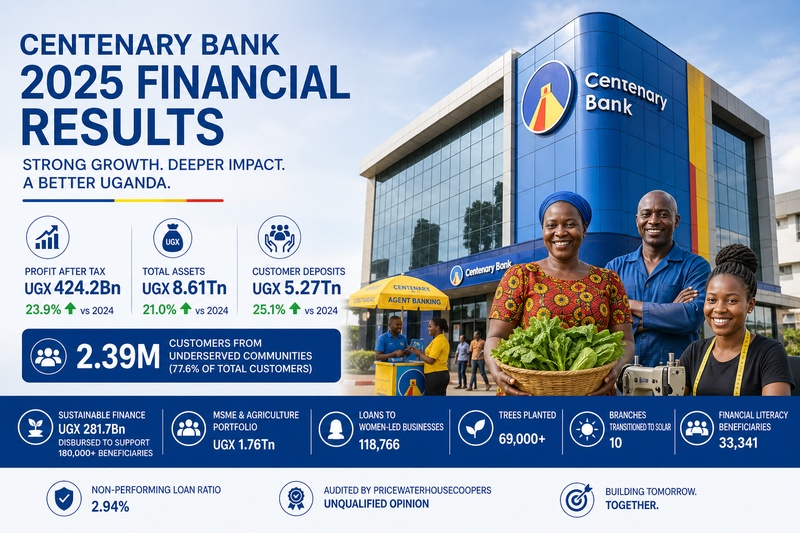
Centenary Bank has closed the 2025 financial year with robust growth across profitability, assets, and customer deposits, reinforcing its position as Uganda’s leading commercial microfinance bank with deep roots in underserved communities.
The bank’s latest results show sustained momentum driven by strong customer confidence, disciplined execution, and continued expansion of financial inclusion initiatives targeting Uganda’s real economy.
Profit after tax rose by 23.9% to UGX 424.2 billion in 2025, up from UGX 342.3 billion the previous year. Total assets also expanded significantly by 21% to UGX 8.61 trillion, reflecting an enlarged balance sheet and increased intermediation of savings into productive sectors of the economy.
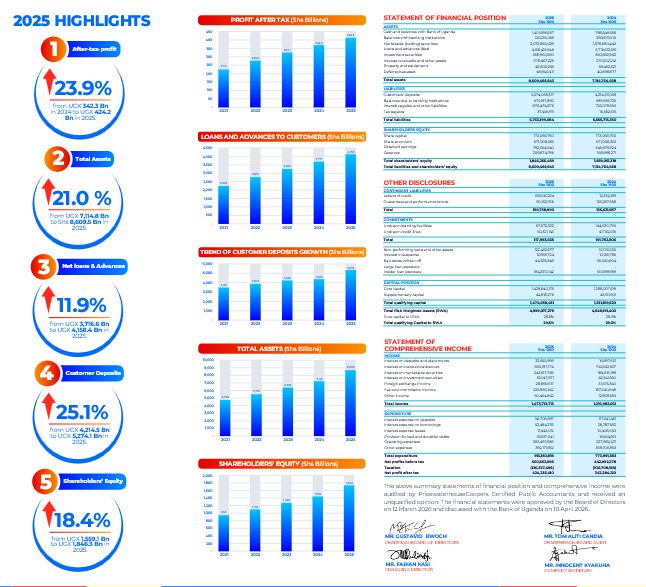
Customer deposits, a key indicator of trust and financial deepening, grew sharply by 25.1% to UGX 5.27 trillion, compared to UGX 4.21 trillion in 2024. Net loans and advances increased to UGX 4.16 trillion, up from UGX 3.72 trillion, as the bank continued to channel credit into agriculture, micro, small and medium enterprises (MSMEs), and household finance.
Shareholders’ equity strengthened to UGX 1.85 trillion, up 18.4%, underscoring improved capital buffers and long-term financial stability.
According to the bank, the performance reflects “sustained customer trust and disciplined execution,” with more Ugandans increasingly choosing Centenary Bank as their primary financial partner.
A defining feature of the 2025 results is the bank’s continued focus on financial inclusion. By year-end, 77.6% of its customer base was drawn from underserved segments, including smallholder farmers, women, youth, refugees, and rural communities.
In total, the bank served 2.39 million customers from these segments, with MSME and agriculture financing reaching UGX 1.76 trillion. Women-led enterprises received loans supporting 118,766 businesses, while 58,519 smallholder farmers were directly financed. Microfinance clients stood at 122,833, reflecting the bank’s continued grassroots penetration.
Agent banking remained a critical delivery channel, accounting for 49% of all transactions, supported by a wide distribution network of branches, ATMs, and more than 9,000 agent banking points across the country.
The bank also continued to scale sustainable finance, disbursing UGX 281.7 billion in 2025 to support over 180,000 beneficiaries. These funds were directed toward agriculture, MSMEs, and social impact initiatives aimed at improving livelihoods and productivity.
Flagship programmes such as GROW, Supawoman, Cente Youth, and the National Youth Venture Capital Fund remained central to unlocking opportunities for women and young entrepreneurs, supporting business growth and long-term financial resilience.
Beyond financial services, Centenary Bank expanded its social and environmental impact. The bank invested UGX 4.9 billion in corporate social responsibility (CSR) initiatives, supporting 1,153 community programmes nationwide. More than 69,000 trees were planted as part of its environmental stewardship agenda, while 10 branches were transitioned to solar energy, contributing to a 6.3% reduction in emissions.
Financial literacy programmes also reached 33,341 beneficiaries, strengthening financial capability at the household level. The bank further participated in nationwide initiatives such as the Rotary Cancer Run, reinforcing its commitment to health and community well-being.
Despite a challenging operating environment, asset quality remained strong, with the non-performing loan ratio contained at 2.94%, supported by tight credit controls and risk management practices. The 2025 financial statements were independently audited by PricewaterhouseCoopers and received an unqualified opinion, affirming the bank’s governance and transparency standards.
Looking ahead to 2026, Centenary Bank says it will focus on enhancing customer experience through a new core banking system, improving operational efficiency, and expanding access to finance across key sectors of the economy.
The bank reaffirmed its long-term mission of empowering individuals, businesses, and communities with financial tools that enable sustainable growth and inclusive development across Uganda.
Here is a full report : https://www.centenarybank.co.ug/dcs/2025-financial-results.pdf