



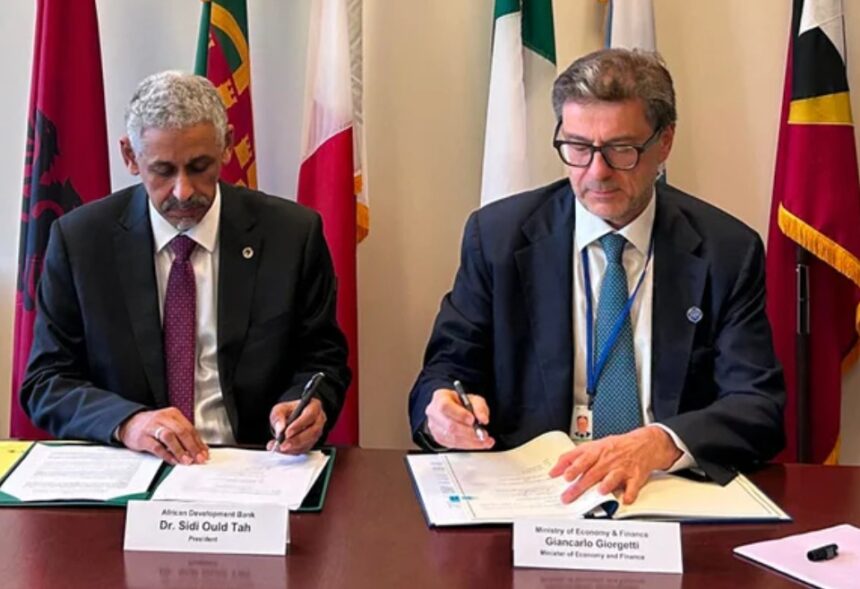
The African Development Bank Group and the Government of Italy have deepened their ties with a fresh co-financing deal aimed at unlocking more investment across Africa’s most critical sectors.
Signed in Washington D.C., the agreement brings together the Bank and Italy’s economic and foreign affairs ministries to channel funding into areas like energy, agriculture, water, infrastructure, and human capital—sectors widely seen as essential to driving long-term growth on the continent.
At the centre of the deal is a €140 million package. This includes €100 million in concessional financing and another €40 million in grants, drawn from Italy’s development cooperation funds. The Bank will manage and deploy the resources alongside its own financing, following its standard rules and safeguards.
For both sides, this is more than just funding—it’s about scale and coordination. The facility is expected to give the Bank more muscle to co-finance large projects, attract additional partners, and push forward investment-led growth across its member countries. It also aligns with broader goals such as job creation, food security, climate resilience, and improving access to energy.
Sidi Ould Tah described the agreement as a reflection of a strong and evolving partnership, noting that it builds on ongoing joint efforts to tackle Africa’s development challenges while fitting into the Bank’s wider strategy of mobilising capital and strengthening partnerships.
On Italy’s side, Giancarlo Giorgetti framed the deal as a practical step under the country’s Mattei Plan for Africa. The plan focuses on fostering long-term, balanced partnerships with African nations, with an emphasis on sustainable investment and shared growth.
The new agreement also ties into existing joint programmes such as the Rome Process/Mattei Plan Financing Facility and the Growth and Resilience Platform for Africa, reinforcing a broader framework that blends public and private financing.
In essence, both Italy and the African Development Bank are betting on a more collaborative model—one that combines funding, partnerships, and institutional support—to address deeper challenges like economic fragility and migration, while creating more resilient and inclusive growth across Africa.