



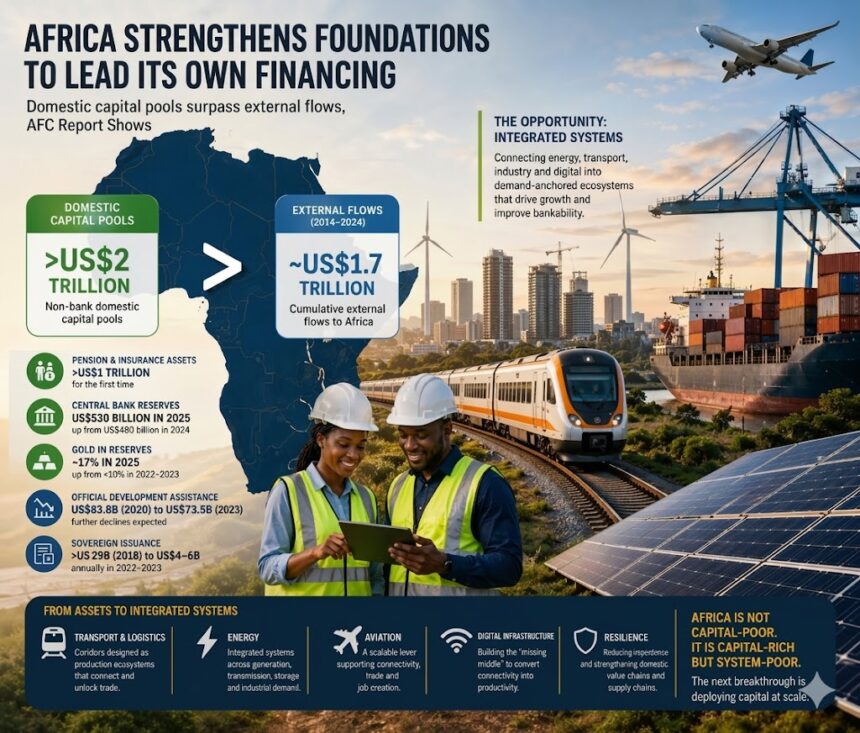
Africa is entering a decisive shift in how it finances development, as domestic capital pools now surpass cumulative external flows, according to the Africa Finance Corporation (AFC) State of Africa’s Infrastructure Report 2026. The report argues that the continent’s next growth phase will depend less on raising external capital and more on efficiently deploying internal savings into infrastructure and industrial development at scale.
The report finds that Africa’s non-bank domestic capital pools exceed US$2 trillion, compared with about US$1.7 trillion in cumulative external flows between 2014 and 2024. It notes that pensions, insurance assets, sovereign wealth funds, and central bank reserves are expanding rapidly, but remain largely underutilised in long-term productive investment.
Speaking at The Africa We Build Summit in Nairobi, Samaila Zubairu, President and Chief Executive Officer of AFC, said the continent’s challenge has shifted from capital mobilisation to intermediation. He stressed that Africa already has sufficient savings, but lacks systems to channel them into infrastructure and industry at scale.
The summit, held in Nairobi and co-hosted by AFC alongside Kenyan President William Samoei Ruto, highlighted the urgency of building stronger financial ecosystems that connect domestic capital to productive sectors.
Institutional capital is rising sharply, with pension and insurance assets surpassing US$1 trillion for the first time. Central bank reserves climbed to US$530 billion in 2025, up from US$480 billion in 2024, while sovereign wealth funds and public development banks continue to expand across the continent.
However, external financing is weakening. Official development assistance declined from US$83.8 billion in 2020 to US$73.5 billion in 2023, with further reductions expected. Sovereign bond issuance remains well below pre-pandemic levels, and foreign direct investment continues to hover at insufficient levels to meet Africa’s infrastructure demand.
The report highlights a strategic shift toward integrated infrastructure systems that combine energy, transport, digital, and industrial networks into coordinated ecosystems. It points to East African developments such as the Mombasa trade corridor and the Naivasha–Kisumu rail extension as examples of infrastructure evolving into production and logistics ecosystems rather than standalone assets.
Energy interconnections like the Ethiopia–Kenya power line and aviation hubs across Kenya, Rwanda, and Ethiopia are also cited as early models of regional integration supporting trade, mobility, and job creation.
Despite these gains, Africa still imports more than 70% of its refined fuel and faces an estimated US$230 billion annual import bill for essential goods, highlighting persistent structural vulnerabilities.
The report concludes that Africa is not capital-poor but system-constrained. Africa Finance Corporation argues that the next breakthrough will come from building institutions, financial instruments, and project pipelines capable of transforming domestic savings into large-scale infrastructure and industrial growth.