



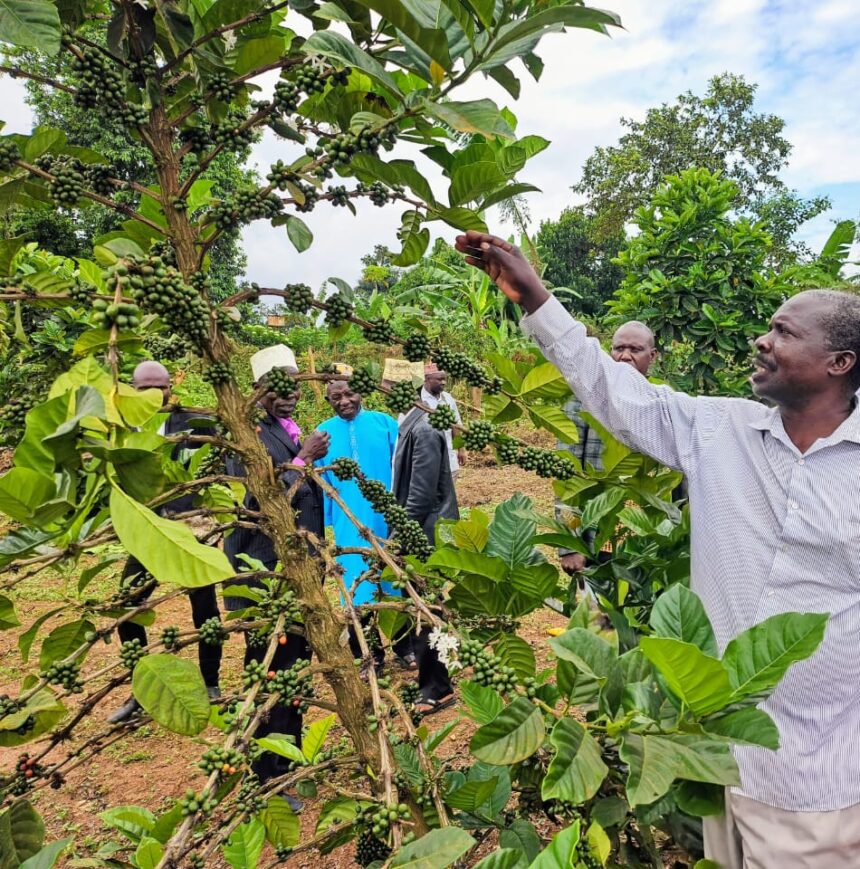
Deep inside Uganda’s tropical forests, scientists at the state-owned National Agricultural Research Organisation say they may have uncovered one of the country’s most strategically important agricultural discoveries in decades — a wild indigenous coffee species with the potential to reshape the future of African coffee production in an era of climate stress.
The species, identified as Excelsa also referred to by some local farmers as Congo or Kiwangazi coffee — is attracting growing attention because of what researchers describe as unusual resilience to drought, disease and rising temperatures.
In a global coffee market increasingly threatened by climate volatility, Uganda’s discovery could hand the East African nation a rare competitive advantage.
For Uganda, coffee is not merely an export crop. It is one of the country’s largest foreign exchange earners, supports millions of households and sits at the center of government industrialization ambitions.
The country currently produces about 9.3 million 60-kilogram bags annually and aims to more than double output to over 20 million bags by 2030 under the National Coffee Planting Programme.
That target has looked increasingly ambitious.
Coffee-producing countries from Brazil to Vietnam and Ethiopia are grappling with erratic rainfall, warming temperatures, pests and shrinking arable land. Arabica — the premium variety favored in global specialty markets — is particularly vulnerable to heat stress, while Robusta, though hardier, is also facing productivity challenges in some regions.
Uganda’s newly identified forest coffee could therefore arrive at a pivotal moment for the global coffee industry.
“We know the coffee center of diversity is in Ethiopia, but this very one is a Ugandan crop,” said Dr. Robooni Tumuhimbise, Director of Research at NARO. According to the scientists, the species emerged naturally from Uganda’s forests and possesses genetic traits capable of improving resistance to climate shocks.
The implications extend far beyond Uganda’s borders.
Globally, the coffee industry has been searching for climate-resilient varieties as fears grow over future supply shortages. Researchers estimate that large portions of current coffee-growing land could become unsuitable by mid-century if temperatures continue rising.
That has triggered a race among producing countries and multinational coffee companies to secure hardier genetic material capable of sustaining yields.
Uganda may now hold one of those strategic assets.
If successfully commercialized, the species could become both a productivity tool and a genetic resource for breeding future coffee hybrids. Scientists at NARO’s Plant Genetic Resources Centre are already conducting characterization and pre-breeding work aimed at transferring desirable traits from the wild species into commercial coffee lines.
Unlike many scientific discoveries that remain trapped in laboratories, Uganda appears eager to rapidly integrate farmers into the process. NARO has begun engaging growers to examine how the species can coexist with existing Arabica and Robusta plantations while increasing farm productivity and climate resilience.
That coexistence model matters.
Rather than replacing Uganda’s established coffee varieties, researchers envision the wild species strengthening the broader ecosystem — improving yields, lowering vulnerability and expanding cultivation into terrains previously considered marginal for coffee farming. For a country under pressure to maintain its status as Africa’s leading coffee exporter, diversification could become essential.
Competition across the continent is intensifying.
Ethiopia continues to dominate premium Arabica branding through its historic coffee heritage, while Vietnam remains a global Robusta powerhouse. Brazil still controls much of the international market through scale and efficiency. Uganda’s advantage has traditionally rested on volume growth and favorable agro-climatic conditions.
But climate change is beginning to erode those advantages globally.
A successful Ugandan climate-resistant coffee variety could therefore elevate the country from being largely a commodity exporter to becoming a source of globally valuable agricultural genetics , a shift that could attract research partnerships, private investment and greater leverage in international coffee markets.
The bigger question now is whether Uganda can move fast enough.
Commercializing a new coffee species requires years of testing, farmer adoption, market acceptance and processing adaptation. Export markets will also demand proof on cup quality, consistency and scalability. Yet if the science holds, Uganda may have discovered more than just another coffee plant.
It may have found a survival strategy for the future of coffee itself.