



Africa’s health research sector could become one of the continent’s biggest economic growth engines, generating an additional $668 billion in GDP over the next two decades if governments aggressively invest in medical innovation, according to a landmark report launched by the Africa Centres for Disease Control and Prevention and European partners.
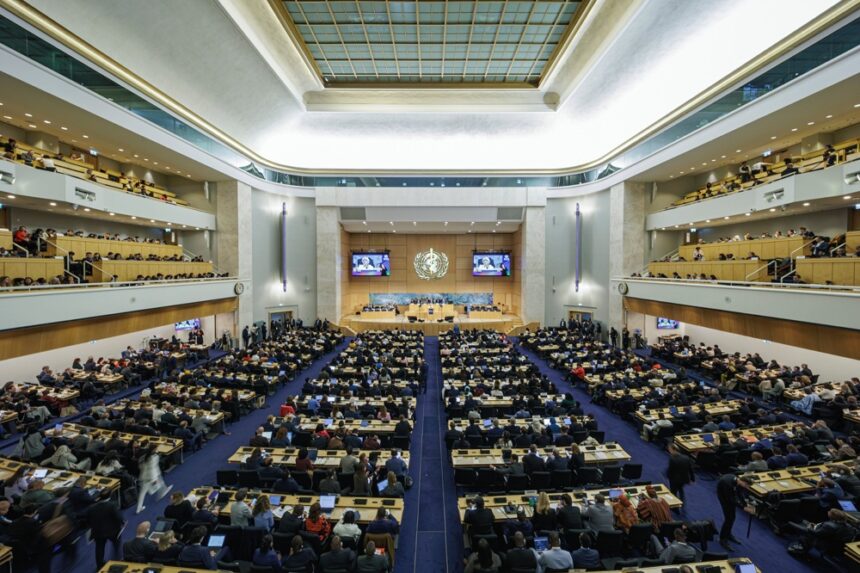
The study, unveiled during the World Health Assembly in Geneva, reframes health research and development not as a social expenditure but as a strategic economic industry capable of driving industrialization, job creation and African self-reliance.
The report arrives as African governments intensify efforts to reduce dependence on imported vaccines, pharmaceuticals and medical technologies following the supply chain shocks exposed during the Covid-19 pandemic.
According to the analysis, achieving the African Union’s target of allocating 1% of GDP to research and development — with at least 15% directed toward health R&D — could fundamentally reshape Africa’s economic trajectory.
The projections are striking.
Africa could create 4.56 million jobs by 2044, attract billions in private capital and generate $137 in economic value for every dollar invested in health innovation, the report says. Investments would effectively pay for themselves within four years.
“This report shows that investing in African health R&D is not only a health priority — it is a pathway to economic sovereignty, industrial growth and resilience,” said Dr. Raji Tajudeen, Acting Deputy Director General of Africa CDC.
“If we do not own Africa’s health, we do not own Africa’s destiny,” he added.
The findings underscore a growing shift in how policymakers and investors are beginning to view Africa’s healthcare sector: not merely as a development challenge, but as an untapped industrial and technological frontier.
Africa currently carries roughly 25% of the global disease burden but captures only a small share of the economic value generated by the worldwide pharmaceutical and biotechnology industries.
Much of the continent still relies heavily on imported medicines, diagnostics and vaccines, leaving countries vulnerable to external supply disruptions and currency pressures.
The report argues that scaling local health research ecosystems could reverse that imbalance by building high-value manufacturing industries, retaining scientific talent and positioning African countries deeper within global biotech and pharmaceutical supply chains.
Several countries are already emerging as early examples of this transition.
The study highlights South Africa’s Afrigen mRNA programme, Rwanda’s partnership with German biotechnology company BioNTech, Egypt’s expanding pharmaceutical manufacturing base and Kenya’s growing clinical research ecosystem as evidence that African-led innovation can attract significant international investment.
Uganda’s Minister for Science, Technology and Innovation, Monica Musenero, described health R&D as “economic infrastructure,” arguing that countries investing in scientific innovation create stronger, higher-skilled economies capable of retaining more value domestically.
The report also warns that failure to invest aggressively could cost Africa more than $1 trillion in lost GDP over the next 20 years while deepening dependence on imported technologies and foreign supply chains.
Behind the economic modelling is a broader geopolitical shift.
As global powers compete for influence in critical industries including biotechnology, pharmaceuticals and advanced manufacturing, African institutions are increasingly pushing for “health sovereignty” — the ability to develop, manufacture and distribute medical products within the continent rather than relying primarily on external producers.
The Africa CDC and Team Europe initiative signals that health innovation is now being positioned alongside energy, infrastructure and digital technology as a strategic pillar of Africa’s long-term economic transformation.