



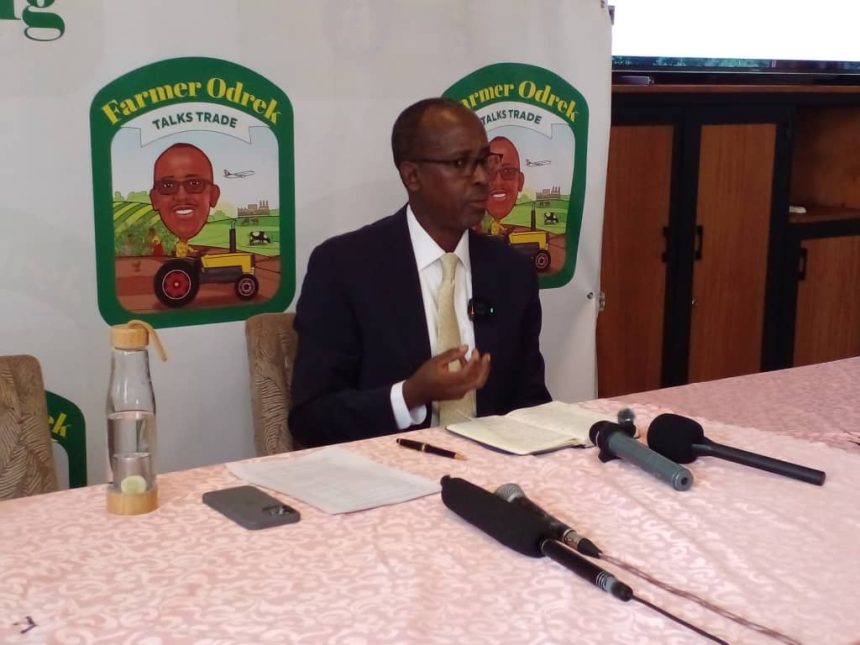
Odrek Rwabwogo, the Chairperson of the Presidential Advisory Committee on Exports and Industrial Development (PACEID), has launched a new radio program titled “Farmer Odrek Talks Trade”, calling on Ugandans to urgently transition from low-value, commodity-based agriculture to high-value processing and industrialization if the country is to achieve its 2030 export and economic transformation goals.
Speaking during the inaugural episode aired earlier today, Rwabwogo emphasized that Uganda’s continued reliance on exporting raw commodities leaves the country vulnerable to global price shocks and diminishes earnings. He illustrated this point by recalling the 2011 Arab Spring, linking its origins to grain export restrictions by Russia due to poor harvests—restrictions that ultimately triggered global food price hikes and unrest in parts of North Africa and the Middle East.
“Commodity-based agriculture keeps us at the mercy of external markets. Our people must rise into the industrial era,” Rwabwogo said, adding that Uganda’s 2030 targets should focus less on volumes and more on value. “It’s not about how many bags of coffee we export, but how much roasted coffee we sell directly into supermarkets in Europe and beyond.”
He revealed that Uganda has already exported a 20-foot container of roasted coffee to Southern Europe, an important milestone in the country’s export diversification strategy. “The price of a cup of coffee hasn’t dropped anywhere in the world, even when farm gate prices fall. That’s where the real money is—in retail, not raw export,” he explained.
Rwabwogo also stressed the importance of transforming exports across other sectors like gold and honey. “We want to export not just gold, but gold-infused products—bangles, medications, dashboard materials. We want to move honey from plastic jars to glass and find shelf space in international supermarkets.”
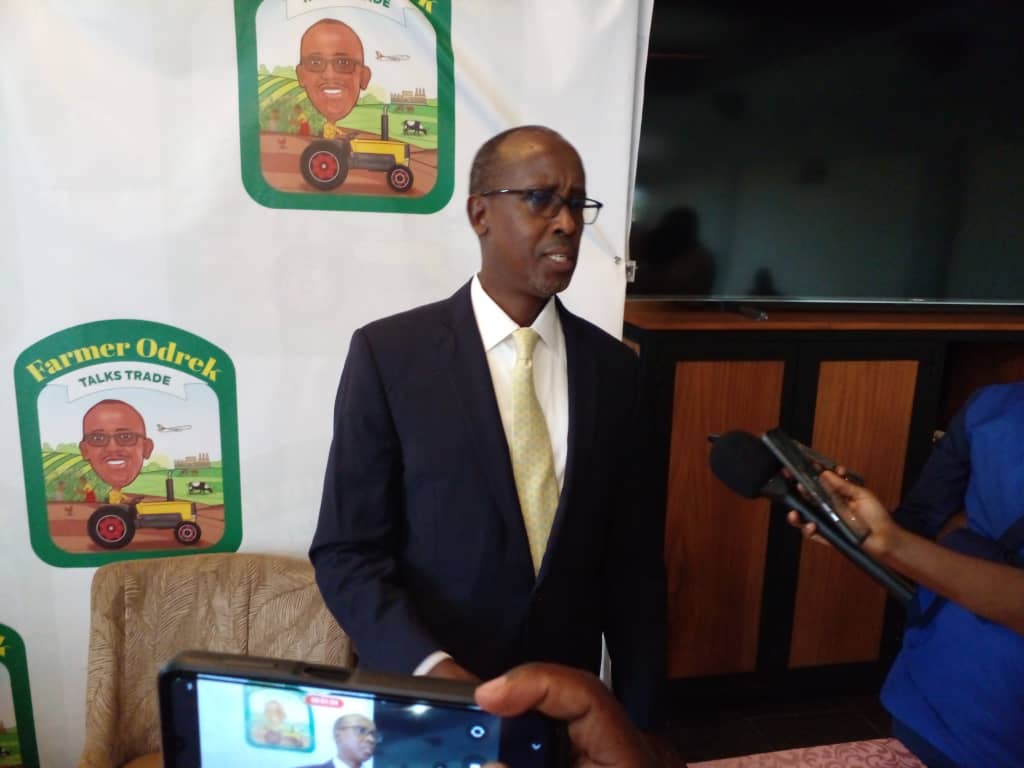
The “Farmer Odrek Talks Trade” show, which will air across radio and digital platforms, aims to demystify trade policy and export strategy for ordinary Ugandans, especially farmers. Rwabwogo expressed concern that agriculture receives little media attention unless sponsored by donor agencies. “We have to talk about agriculture ourselves—on our own platforms, in our own voices,” he urged.
Touching on the African Continental Free Trade Area (AfCFTA), he lamented that, despite signing the agreement in 2018, Uganda still faces non-tariff barriers in accessing major African markets such as Nigeria. “We’re struggling to export pharmaceuticals, milk, and coffee into Nigeria because of rules of origin disputes. Many African countries sign trade agreements but do not implement them,” he said.
He added that Uganda’s best opportunity lies in selling value-added goods within the region. “Forty-five percent of our manufactured goods—plastics, electronics—are sold in East Africa. But for agriculture, the challenge is value capture. For example, we exported 10 million liters of milk to Kenya, yet we have capacity for 30 million. Non-tariff restrictions are killing our potential.”

Rwabwogo also addressed the controversial 15% U.S. tariff on Ugandan goods, particularly roasted coffee, arguing that the move is unnecessary given the relatively balanced trade between the two nations. He noted that Uganda has successfully shipped roasted espresso to parts of the U.S., and the tariff threatens to undercut that nascent success.
To scale Ugandan exports, Rwabwogo outlined three pillars: skills, incentives, and market access. “Scaling a business like Senoga’s honey enterprise requires skilled HR, sound finance management, and access to favorable export finance,” he said. “We also need sector-wide incentives, not just for individual firms.”
He concluded by calling on government and private stakeholders to coalesce around strategic value chains—coffee, dairy, honey, and gold—and provide the necessary infrastructure, finance, and trade diplomacy to unlock Uganda’s full potential.
“Our journey to a $500 billion economy depends on how we manage energy, roads, and exports. It’s about productivity. In 1830, it took 344 hours for a U.S. farmer to produce 25kgs of grain. By 1980, it took three hours. That’s the power of innovation. That’s where Uganda must go,” Rwabwogo said.
The show is expected to air weekly, with multilingual programming to reach rural audiences across Uganda.