



Tanzania’s soybean industry is undergoing a remarkable transformation, with production increasing more than tenfold over the past decade, creating fresh opportunities for seed companies, farmers, and agribusiness investors seeking to tap into one of East Africa’s fastest-growing agricultural markets.
According to new findings released by the Soybean Innovation Lab (SIL), Tanzania’s soybean production has surged from between 3,000 and 5,000 metric tons annually in the 2010s to more than 48,000 metric tons during the 2024 growing season.
Despite this rapid expansion, the country is still producing only about one-sixth of its estimated annual demand of 300,000 metric tons, highlighting significant room for growth.
The report notes that soybean cultivation is concentrated mainly in Tanzania’s Southern Highlands, although the country’s diverse geography—from the humid Indian Ocean coastline to the high-altitude slopes of Mount Kilimanjaro and the semi-arid central plateau—creates vastly different growing conditions that require carefully selected seed varieties.
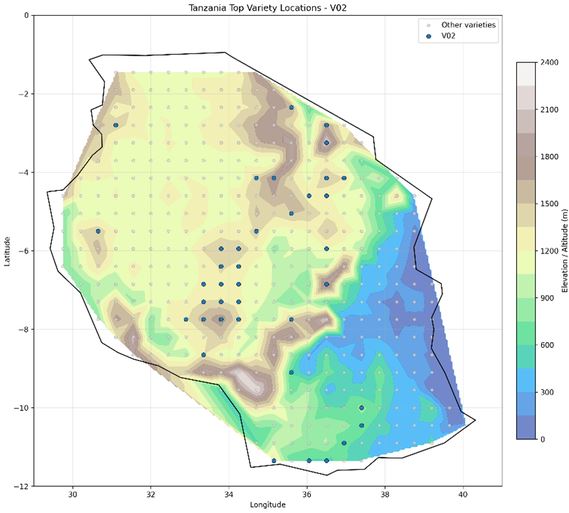
To address this challenge, SIL has deployed its proprietary Head-to-Head™ predictive varietal model, which uses historical field trial data and environmental variables to determine which soybean varieties are most likely to deliver the highest yields across different production zones.
The model analysed Tanzania using thousands of geo-locations, each defined by unique combinations of latitude, longitude, elevation and weather conditions.
Drawing from a database containing yield performance data for 233 soybean varieties, the system predicts the best-performing variety for each location.
One soybean variety, identified as V01, emerged as the standout performer, with projections showing it would deliver the highest yields in approximately 63 percent of Tanzania’s production environments.
The variety performs particularly well across the country’s northern regions at moderate to high elevations while also maintaining strong productivity in semi-arid areas, making it the most versatile option for large-scale deployment.
However, the analysis also highlights that Tanzania cannot be treated as a single production environment. Instead, several specialised varieties are better suited to specific ecological zones.
Variety V02 is projected to excel in the high-elevation semi-arid corridor stretching from Mbeya to Mount Kilimanjaro, accounting for around 10 percent of recommended locations.
V03 performs best in the wetter south-eastern lowlands, while V04 is best suited to the high-rainfall south-western regions.
Meanwhile, V05 shows strong potential in north-eastern highlands, and V06 is recommended for the country’s low-lying eastern coastal belt.
The findings could help accelerate Tanzania’s efforts to narrow its soybean supply gap by enabling seed companies to market varieties that are specifically matched to local growing conditions rather than relying on a one-size-fits-all approach.
SIL cautions that the recommendations are based on historical Pan-African field trial data and environmental modelling rather than guaranteed field performance.
Nevertheless, the predictive approach offers a valuable decision-support tool for seed developers, distributors and commercial farmers looking to improve productivity and strengthen Tanzania’s soybean value chain.
With domestic demand continuing to outpace production, better-targeted seed investments could play a pivotal role in boosting yields, reducing imports and positioning Tanzania as a major soybean producer in East Africa.