



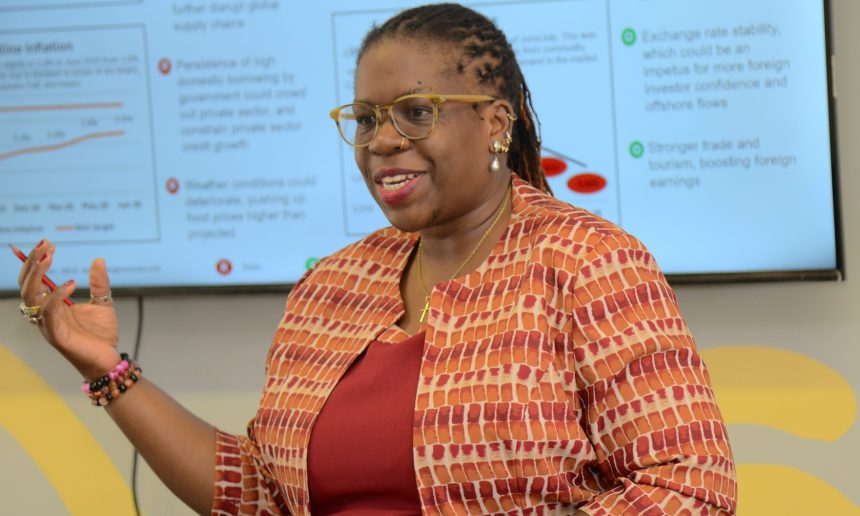
During a recent Absa Journalism Masterclass held at Makerere University, Catherine Kijjagulwe, Head of Trading at Absa Bank Uganda’s Corporate and Investment Banking (CIB) Markets division, emphasized the critical role of journalists in shaping public understanding of Uganda’s financial markets.
Kijjagulwe urged journalists to focus on key economic indicators such as exchange rates, interest rates, inflation, oil prices, and gross domestic product (GDP) growth when reporting on the economy. She stressed that accurate and accessible financial reporting is essential for enabling businesses and investors to make informed decisions, particularly amid the current economic uncertainties.

“Once journalists are able to give proper facts about the economy, it enables us to disseminate this information effectively to the public,” Kijjagulwe said. “Journalists are our gateway to the market.” She also encouraged the media to present information in local languages and simple terms to broaden understanding across diverse audiences.
On Uganda’s financial market outlook, Kijjagulwe noted that Absa Bank is strategically positioning itself to support government priority sectors including agriculture, tourism, minerals, and technology. The bank is developing tailored financial products that help clients hedge against risks such as exchange rate fluctuations and interest rate changes.
Regarding interest rates, Kijjagulwe acknowledged that borrowing costs in Uganda remain high due to inflation and elevated government borrowing through treasury bills and bonds. However, she expressed optimism that as the government diversifies its financing sources and offshore investment increases — particularly with the anticipated start of oil exports — interest rates may ease, providing relief for borrowers.
Kijjagulwe also highlighted ongoing government efforts to improve access to affordable financing for the broader market, citing initiatives like “grow loans” and funding mechanisms under the Parish Development Model (PDM).

Looking ahead to the oil and gas sector, she explained that Absa Bank aims to introduce financial market products that allow businesses to hedge not only currency and interest rate risks but also commodity risks related to oil and other resources.
Lastly, on the topic of pensions and local investment, Kijjagulwe pointed out Uganda’s low score on the Africa Financial Markets Index, which reflects limited participation by local investors in government securities. She noted that the Central Bank is actively conducting workshops and exploring mobile platforms to boost local investment in government bills and bonds. Increasing the pool of local investors could reduce reliance on banks and pension funds and potentially lead to lower interest rates.
The masterclass marked a key collaboration between Absa Bank and Makerere University to enhance journalists’ capacity to report on complex financial matters, ultimately strengthening public financial literacy and market development in Uganda.