



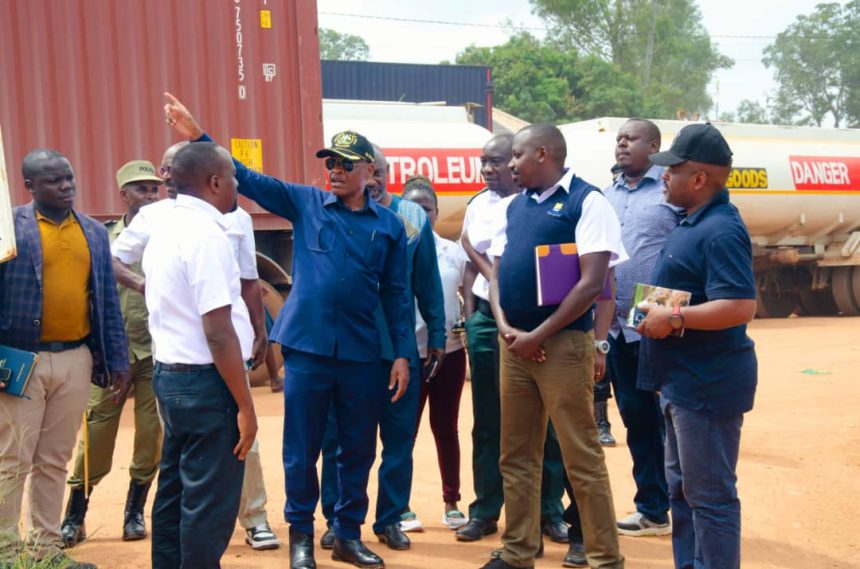
Uganda’s Minister of State for Trade, Gen. Wilson Mbasu Mbadi, has announced plans to hold talks with his Democratic Republic of Congo (DRC) counterpart to address persistent barriers affecting cross-border trade, despite recent infrastructure upgrades along Uganda’s western and northern frontiers.
The minister made the commitment during a week-long inspection of border posts in the Rwenzori and West Nile regions. His tour covered Mpondwe in Kasese, Ntoroko on Lake Albert, Goli in Nebbi, Padea in Zombo, Vurra and Lia in Arua, as well as Oraba in Koboko, which connects Uganda with South Sudan. The visit was aimed at assessing trade facilitation, revenue collection and operational challenges.
Uganda has invested in modernising border facilities, with support from UKaid and TradeMark Africa. Mpondwe, Ntoroko and Goli were upgraded into One-Stop Border Posts (OSBPs) in 2022 to streamline cargo clearance and reduce costs. But Gen. Mbadi said the facilities remain underutilised because of poor coordination with DRC authorities and lack of critical agencies on the Ugandan side.
At Ntoroko, Uganda Revenue Authority (URA) officials reported that DRC border agencies do not attend joint meetings and traders face delays. Similar complaints were recorded at Vurra, Padea and Lia. Traders further accused DRC of mistreating Ugandan exporters, forcing them to sell through Congolese middlemen who sometimes fail to pay. They also cited losses from multiple currency exchanges and lack of storage facilities for perishable goods such as fish.
Other challenges include poor road access, limited parking for trucks, unreliable power supply at border posts, and insecurity from armed militias across the border. Ugandan immigration officials said DRC still charges Ugandan traders $50 for entry visas, despite its admission into the East African Community (EAC) in 2022. Uganda, by contrast, scrapped visa fees for Congolese nationals in line with the EAC Common Market Protocol.
Traders at Mpondwe complained of high URA taxes on fish, while others demanded construction of export zones and cold storage facilities to support cross-border business. At Ntoroko, border agencies spend UGX 10 million monthly to fuel generators due to lack of grid power, which has hindered the use of cargo scanners.
Gen. Mbadi pledged government action, saying Uganda will formally engage DRC to harmonise operations, remove visa fees and deepen customs integration. He added that he will involve the ministries of works, energy and defence to improve roads, electricity and security at border posts.
“Very soon, we are going to hold a ministerial meeting with my DRC counterpart to iron out these barriers just like we recently did with Kenya,” he said.
Despite the challenges, officials reported rising trade volumes. Uganda’s exports to DRC have doubled from USD 500 million in 2020 to over USD 1 billion in 2025. Revenue at Mpondwe border alone reached UGX 8.7 billion in 2024/25, slightly above target, while collections at Ntoroko jumped from UGX 196 million in 2022/23 to UGX 1.06 billion last year.
DRC remains Uganda’s top export destination in both the EAC and COMESA, with key goods including cement, wheat flour, sugar, beverages, plastics and agricultural produce.