



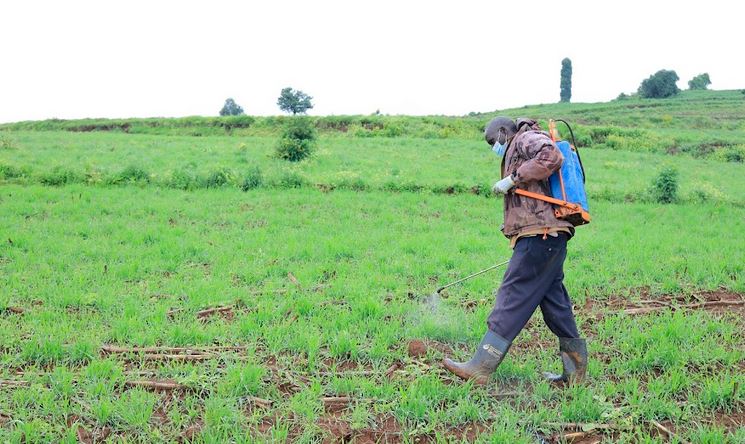
Uganda Breweries Limited (UBL) is deepening its investment in climate-smart agriculture across eastern Uganda, betting that cleaner water, renewable energy and regenerative farming will strengthen both rural livelihoods and the company’s long-term supply chain resilience.
Through its partnership with Aidenvironment under the Elgon Pamoja initiative, the brewer has committed more than UGX 1 billion since 2024 to transform farming communities across Kapchorwa, Bukwo, Kween and Bulambuli districts — a strategically important agricultural belt that supplies barley, sorghum and maize to the company.
The programme is rapidly emerging as one of Uganda’s most ambitious private-sector-led rural sustainability projects, combining ecosystem restoration with income generation in a region increasingly threatened by soil degradation, erratic rainfall and deforestation.
Across the Mt. Elgon catchment, newly installed communal water tanks, biogas digesters and contour terraces are already reshaping daily life for thousands of farming households. The intervention is designed not only to improve agricultural productivity but also to reduce the environmental pressures that have destabilized one of Uganda’s most fertile highland regions.
UBL currently works with more than 5,850 farmers in the Elgon region, supporting over 11,500 cultivated acres tied directly to its local sourcing network.
“Our goal is to build resilient farming communities while strengthening sustainable local sourcing,” said Yudaya Anita, Market Specialist at Uganda Breweries Limited and Agronomy Manager for the Elgon region.
“When farmers have access to water, cleaner energy and improved farming practices, families earn more, communities become healthier and agriculture becomes sustainable for future generations.”
The company’s strategy reflects a growing shift among multinational consumer brands operating in Africa: protecting supply chains increasingly requires direct investment in climate adaptation and rural infrastructure.
In Bukwo and Kween districts, farmers say the programme is already delivering measurable economic gains. Households that once spent hours searching for water now rely on communal storage systems that support both domestic use and small-scale irrigation. Meanwhile, biogas units powered by livestock and crop waste are cutting household fuel costs while reducing dependence on firewood.
For barley farmer Alex from Kween district, the changes have been transformational.
“Since I switched to barley farming, my life completely changed,” he said. “I expanded my land, built houses and educated my children. In our community, barley is now called the school fees crop.”
UBL says early field data from demonstration sites shows crop yields rising between 30% and 40%, while fuelwood consumption has declined sharply in villages using biogas technology.
The broader environmental strategy includes tree planting, riparian restoration and engineered terraces intended to stabilize slopes around Mt. Elgon , an area historically vulnerable to soil erosion and landslides.
With the brewing industry, the stakes are increasingly commercial as well as environmental. Climate volatility continues to threaten crop consistency, raising pressure on manufacturers dependent on local agricultural inputs.
By tying farmer incomes directly to sustainable land management, UBL is positioning Elgon Pamoja as more than a corporate social responsibility project. The initiative is becoming a business continuity strategy, one where protecting ecosystems, stabilizing rural communities and securing raw material supply are now inseparable.