



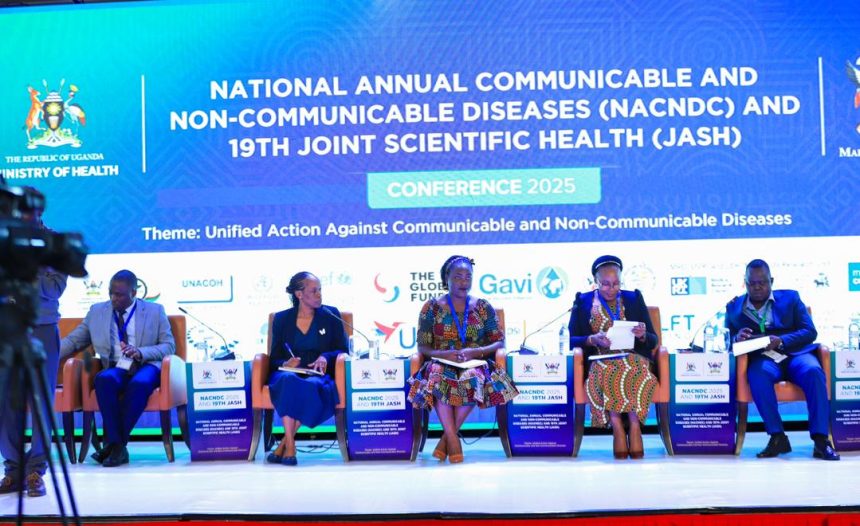
Health experts, policymakers, and private sector leaders have called for stronger, more consistent collaboration across all sectors to address Uganda’s rising disease burden, especially non-communicable diseases (NCDs).
Speaking during a panel session at the ongoing National Health Conference, panellists agreed that Uganda’s health challenges can no longer be solved by the health sector alone and require a “whole-of-society” approach.
Grace Kiwanuka, Executive Director of the Uganda Healthcare Federation, said that while the private sector has made significant contributions to improving health services, its full potential in promoting disease prevention remains underutilised.
“The private sector is often seen only as a service provider or funder,” she said. “But it’s much bigger than that—it includes manufacturers, ICT companies, transporters, educators, and logistics providers, all of whom directly or indirectly influence the nation’s health outcomes.”
Kiwanuka explained that the Federation, which represents private health actors ranging from hospitals to pharmaceutical firms, works closely with the Ministry of Health to strengthen public-private partnerships. However, she noted that collaboration across sectors remains fragmented and mostly reactive.
“As a country, we tend to engage the private sector only during emergencies—COVID-19, Ebola, or natural disasters,” she said. “But when the crisis ends, communication stops, and we lose the chance to build long-term systems that support prevention and health promotion.”
She cited examples of how private companies have invested in diagnostic services and screening initiatives for NCDs but lamented that such efforts remain uncoordinated.
“Non-communicable diseases like diabetes and hypertension are not attractive areas for corporate investment because their impact is gradual,” she said. “We need a coordinated national approach that demonstrates value for all partners involved.”
Dr. Isaac Ssenabulya, a consultant cardiologist at the Uganda Heart Institute, echoed Kiwanuka’s call for a deliberate and sustained multisectoral model. “If I were to redesign Uganda’s approach to disease prevention, I would start from the community,” he said.
“Sixty percent of these diseases are found in communities, not hospitals. We need to empower people where they live, work, study, and worship.”
Dr. Ssenabulya, who also heads the Uganda Initiative for Integrated Management of NCDs, emphasised that prevention begins with education and awareness. He urged policymakers to integrate health education into school curricula and promote healthy lifestyles in workplaces, markets, and religious institutions.
“You find someone selling fruits but eating junk food for lunch,” he said. “That shows how much we need to reorient people on healthy living. Education, ICT, agriculture, and even infrastructure sectors must work together—right from ensuring safe walkways and green spaces to promoting access to nutritious foods.”
He further called for the use of ICT and data-driven solutions to strengthen community-level disease monitoring and policy planning. “Data helps us see what’s working and where the gaps are,” he said. “We need to map health risks and design interventions based on real-time evidence.”
Representing the Office of the Prime Minister (OPM), Mr. Aguma Bazil pointed to several successful examples of cross-sector collaboration, including the Parish Development Model (PDM), Uganda’s COVID-19 response, and disaster management initiatives.
“The Parish Development Model has brought together ministries of local government, agriculture, finance, ICT, and gender, creating a coordinated structure that supports community livelihoods,” he said. “Similarly, during COVID-19, different sectors—including security, trade, education, and local governments—worked together, making Uganda a model for regional response.”
Aguma added that such integration must be applied beyond emergencies. “To address NCDs, we must move with the same energy we saw during COVID-19,” he said. “Collaboration ensures inclusiveness, community participation, and a faster, more effective response to health threats.”
Dr. Shirley Kansabe, a research officer at Kyambogo University and PhD candidate at Makerere University School of Public Health, highlighted the Uganda Nutrition Action Plan (UNAP) as one of the country’s most successful examples of sustained multisectoral action.
“UNAP brings together 13 ministries and government agencies, coordinated by the Office of the Prime Minister,” Kansabe said. “This structure has led to measurable improvements in nutrition, including reductions in stunting rates among children.”
She explained that success has been achieved through clear coordination mechanisms, regular meetings, and institutional buy-in from ministries such as education, water, and gender.
“When you go to the Ministry of Water, you find staff actively promoting nutrition awareness in their programmes. That’s what real collaboration looks like,” she said.
Kansabe, however, cautioned that sustained progress requires continued funding and capacity building at district levels. “District Nutrition Coordination Committees are vital for implementation, but many still lack resources. We must ensure that multisectoral collaboration works not only in Kampala but across the country,” she noted.
In closing, panellists agreed that achieving universal health coverage and reversing the rise of NCDs will require institutionalising collaboration across government, private, and community actors.
“Health is everyone’s business,” Kiwanuka concluded. “We must move away from crisis-driven partnerships and build long-term, coherent systems that make prevention and wellness a shared national responsibility.”