




The Uganda Communications Commission (UCC) has moved to enforce a ban on split-screen advertising during news and current affairs programming, following a formal complaint lodged by AdLegal Uganda, a competition and consumer protection law firm.
The petition, submitted to the regulator late last year, accused NBS Television of breaching the UCC Advertising Standards by running commercial content simultaneously with editorial programming, during their shows; The Morning Breeze,NBS Eagle and NBS Frontline.
AdLegal argued that the use of split-screen adverts during live news shows and talk programmes blurred the line between journalism and advertising, undermining consumer protection principles and editorial independence.
In its submission, AdLegal cited provisions of the UCC Advertising Standards (2019), which restrict split-screen and overlay advertising, particularly during news and current affairs. The firm maintained that such practices expose viewers to covert advertising and compromise the credibility of news content by placing commercial messages alongside serious public-interest discussions.
In their defense, NBS Television argued that the law did not provide for “sqeeze backs” which they said was not split-screen advertising as was being reported.
NBS Television described a squeezeback as, ‘a sequence of television footage or a graphic produced specifically to promote a sponsor which is screened from time to time during the broadcast for a duration of approximately 10 seconds which is shown when the main picture is reduced in size in order to allow such footage or graphic to be screened in the available space on the screen surrounding the actual picture it is a process that reduces the size of a video or image so such as a television display, to allow other items such as logos, text crawls, or graphics to be seen in the display area.’
However,the complainant maintained that the phrase ‘sqeeze backs’ was merely an alternative terminology to split screen adverts,since the activity involves simultaneous exposure of current affairs and advertising content, and the probable outcome is that of distraction of the audience and reduction of programme effectiveness.
UCC observed that, “the said definition falls squarely with what is described as “split-screen advertising” in Annex VII, Clause 3 of the UCC Advertising Standards 2019.”
“The mere fact that squeezebacks only consume 20 to 30 percent of the screen does not in itself preclude it from being classified as a form of split-screen advertising. It remains in substance just but another form of a split-screen advert as per the law.”
“The language of the advertising standards is inclusive. It states that split-screen advertising shall not exceed 50% of screen space. This means that any percentage of screen utilized falls under the category of a split-screen advert,”noted UCC in their response.
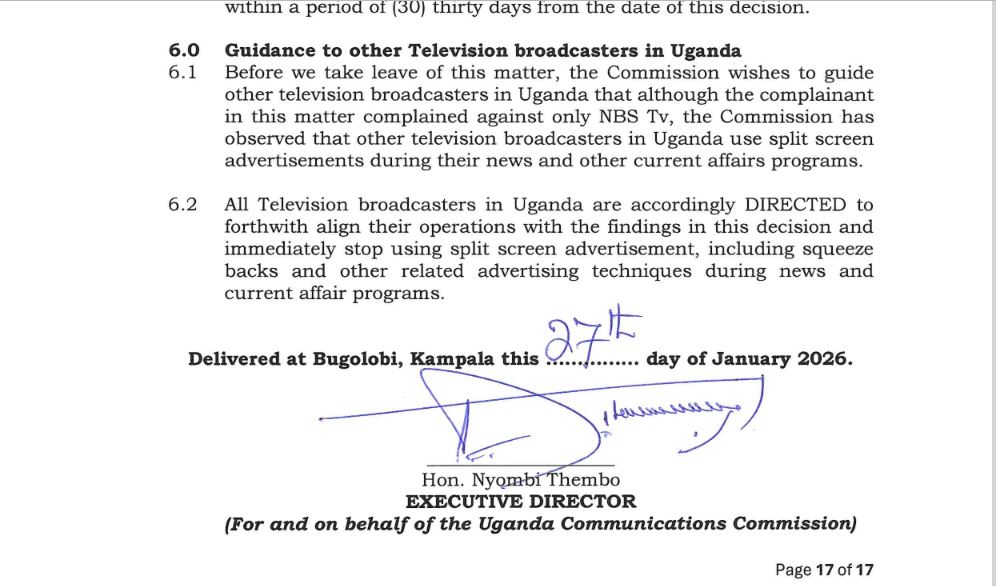
Following a review of the complaint, UCC issued directives reminding broadcasters that split-screen advertising is prohibited during news and current affairs programming, except in narrowly defined cases such as sports broadcasts where such formats are explicitly allowed.
The regulator warned that continued non-compliance would attract sanctions, including penalties and possible suspension of offending advertising formats.
UCC said the decision was aimed at safeguarding editorial integrity and ensuring a clear separation between commercial and journalistic content, in line with its mandate under the Uganda Communications Act. The commission emphasised that news programming carries a special public responsibility and must not be diluted by intrusive or misleading advertising techniques.
The enforcement has already prompted broadcasters to adjust their advertising formats, with several stations reportedly pulling split-screen adverts from flagship news programmes.
Media players say the move will have revenue implications in the short term but acknowledge that it reinforces ethical broadcasting standards.
The development marks a significant regulatory intervention in Uganda’s media and advertising space, signalling tighter oversight of emerging advertising practices as broadcasters seek new revenue streams in a highly competitive market.