



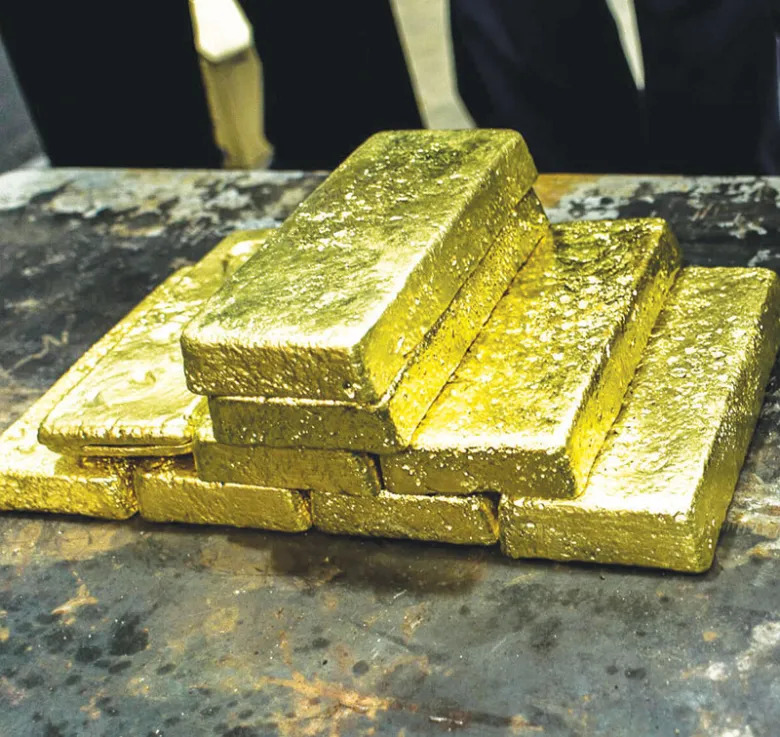
The Bank of Uganda has declared that it is “extremely ready” to enter the gold market, outlining a structured purchase programme aimed at strengthening foreign exchange reserves and formalising the trade.
Responding to questions about how investors can participate in the gold business, the Deputy Governor, Prof. Augustus Nuwagaba while appearing on a panel, said gold now stands out as Uganda’s leading material commodity export.
“What does that show you? It shows that gold is the material commodity export,” he said, noting that the commodity currently accounts for about $6.4 billion in export receipts, ahead of coffee at $2.4 billion and cocoa at roughly $700 million.
He acknowledged, however, that gold also dominates Uganda’s import bill. “When you go into the trading balance for gold only, it is about $20 billion,” he said, adding that this imbalance implies much of the gold traded may not originate locally. “Most possibly, it is not ours. That’s the simple English language,” he remarked.
To address transparency and maximise national benefit, Nuwagaba said the central bank has introduced traceability requirements under its gold purchase programme. “We want to be able to track where we are getting that gold from, whether it’s from Busia, from Kasanda, from Karamoja and so forth,” he said.
The Bank has already pre-qualified three companies to participate in the programme, with two fully approved and one pending clearance.
“We are going to be buying from you,” he said, emphasising that the central bank will purchase gold in quantities of one kilogramme and above. “If you have one kilogramme and above… bring it. The Bank of Uganda will buy it from you.”
Uganda’s gold trade is tightening its grip on the country’s export economy, with policymakers and economists increasingly pointing to the mineral as both an opportunity and a structural challenge for the region.
However the structure of the trade tells a more complex story. While export figures are high, gold imports are also significant, leaving a narrower net trade balance than headline numbers suggest.
“That tells you something fundamental,” Nuwagaba noted. “It implies that much of the gold we export may not necessarily originate from Uganda. We are acting as a regional trading and refining hub.”
Uganda’s strategic location has made it a conduit for gold flows from neighbouring countries in the Great Lakes region, particularly eastern Democratic Republic of Congo and South Sudan. This has boosted forex inflows but also raised questions about traceability, value addition and long-term sustainability.
To address this, the Bank of Uganda’s gold purchase programme is being anchored on traceability and formalisation to build official reserves while strengthening oversight across the supply chain.
“We are extremely ready,” Prof.Nuwagaba said, emphasising that the programme is designed for serious business players rather than short-term speculators. Nuwagaba reinforced this point, arguing that Uganda’s gold strategy must be rooted in productive enterprise.
“Ugandans must stop chasing quick money. Real wealth is built through structured business,” he said. “If you have licensed gold, if you are compliant, the central bank is your guaranteed buyer.”
He further stressed the importance of knowing the origin of gold noting that global markets increasingly demand proof of ethical sourcing. Without traceability, he warned, Uganda risks reputational damage in international bullion markets.
Beyond reserves accumulation, Nuwagaba sees gold as a tool for macroeconomic stability. With remittances and tourism each contributing roughly $1.7 billion annually to forex inflows, gold’s dominance offers an opportunity to diversify Uganda’s reserve assets and strengthen the shilling against external shocks.
Regionally, Uganda’s strategy places it in competition with established African gold exporters such as Ghana, Tanzania and South Africa. However, Nuwagaba argues that Uganda’s comparative advantage lies in becoming a regulated, transparent and efficient trading hub.
“If we formalise the sector, enforce traceability and deepen value addition, gold can anchor Uganda’s position in Africa’s mineral economy,” he said. “But it must be done properly. Otherwise, we remain a transit corridor instead of a wealth creator.”
The coming months will test whether Uganda can convert its booming gold trade into sustainable, locally anchored economic transformation.