



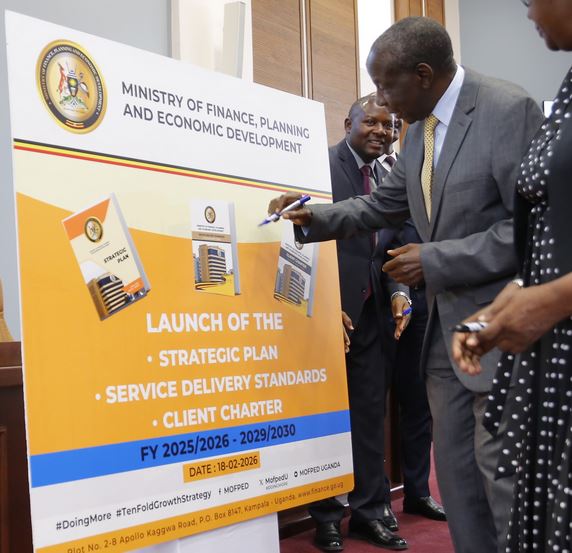
Uganda’s Ministry of Finance, Planning and Economic Development (MoFPED) has unveiled a comprehensive Strategic Plan, Client Charter, and Service Delivery Standards covering 2025/26 to 2029/30, documents officials say will drive fiscal discipline, public investment efficiency, and private sector growth.
While the launch was hailed as a milestone in public sector management, a closer look reveals an ambitious roadmap aimed at transforming the Ministry into a central driver of Uganda’s Tenfold Growth Strategy.
The Strategic Plan is built around six key pillars designed to tackle longstanding challenges in public finance management.
These include strengthening macroeconomic and fiscal policy credibility, mobilising and coordinating financing instruments to reduce the cost of capital, expanding sustainable development financing, improving public investment management, enhancing expenditure efficiency, and building institutional capacity for governance and service delivery.
According to Permanent Secretary Dr. Ramathan Ggoobi, the goal is to “establish and sustain fiscal policy credibility, efficient public investment, and coordinated development financing as the foundation for tenfold economic growth.”
In practice, this means the Ministry intends to maintain disciplined fiscal management, increase domestic revenue mobilisation, and ensure public spending delivers measurable returns.
Finance Minister Matia Kasaija emphasized the link between fiscal credibility and investor confidence, stressing that a predictable and transparent fiscal environment is critical for attracting private capital and sustaining macroeconomic stability.
“Our agenda is ambitious: to achieve at least 8% economic growth, reduce poverty, create jobs, and sustain macroeconomic stability,” he said.
The documents also outline flagship interventions including financing the commercialisation of oil and gas, capitalising government development banks and schemes, supporting industrial transformation, empowering women entrepreneurs, and making household development programmes more effective in transitioning families into profitable enterprises.
Deputy Secretary to Cabinet Dr. Theopista Wenene, representing the Head of Public Service, praised MoFPED for setting service delivery benchmarks, noting that the Client Charter and Service Delivery Standards reinforce accountability, performance management, and results-oriented governance.
While the plan provides a strategic framework, analysts caution that execution will be the critical test. The Ministry’s ability to translate these documents into tangible outcomes — improved investment flows, enhanced infrastructure financing, and measurable social and economic impact — will determine whether Uganda achieves its stated tenfold growth ambitions.
The launch signals a clear government commitment to fiscal discipline, public sector accountability, and structured private sector engagement, offering both opportunities and expectations for those looking to participate in Uganda’s next phase of economic expansion.