



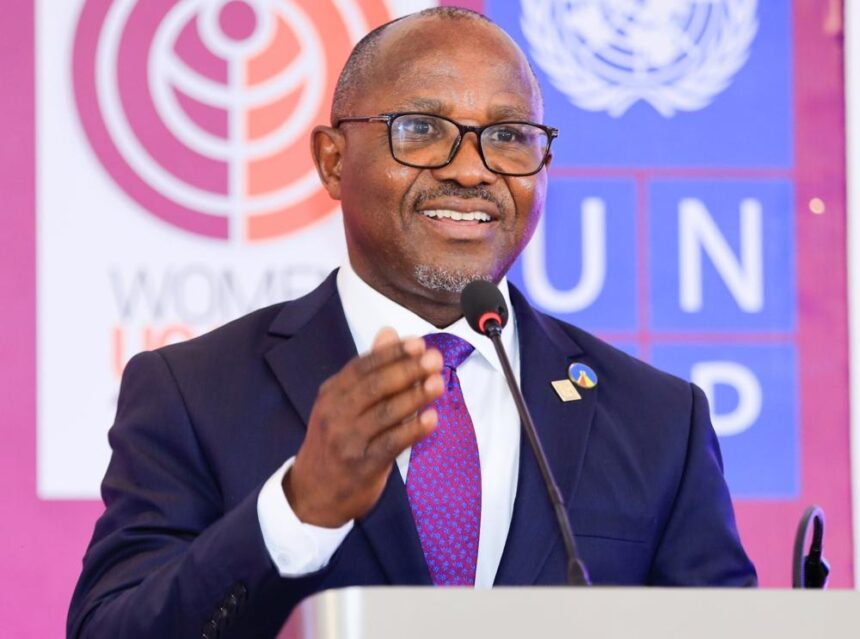
Centenary Bank Uganda Managing Director and CEO Fabian Kasi has reaffirmed the bank’s long-term commitment to women’s economic empowerment, positioning it as a central driver of Uganda’s growth, during remarks at the SheCounts Financial Fair in Kampala.
Addressing a largely female audience, Kasi said the time had come to shift the financial conversation around women from basic survival and savings to wealth creation, investment, and influence.
“For too long, the financial dialogue surrounding women has been relegated to micro survival,” he noted. “Today, we are pivoting towards a more ambitious horizon—one where women grow their finances, lead, and shape economic outcomes.”
Kasi framed women-led enterprises as critical to Uganda’s economic trajectory, particularly as the country pushes toward middle-income status by 2027. He cited internal and industry data showing that women-owned businesses account for roughly 40 percent of micro and small enterprises, many of which operate in high-impact sectors such as agriculture, retail, hospitality, and manufacturing.
“These enterprises are no longer marginal players. They are central pillars of Uganda’s economic transformation,” he said, adding that the MSME sector contributes close to 80 percent of GDP.
However, he acknowledged persistent gaps in financial literacy, pointing to earlier survey findings that placed women’s financial knowledge below that of men. He described this not as a setback, but as “a massive opportunity” for targeted intervention.
Through initiatives like SheCounts, the bank is rolling out structured learning programs, investment clinics, peer forums, and tailored advisory services aimed at equipping women with skills in savings, pensions, insurance, capital markets, and entrepreneurship financing.
Kasi said the goal is to demystify complex financial tools—from treasury bonds to international markets—while encouraging disciplined saving, risk management, and long-term planning.
Centenary Bank’s internal programs are already showing scale. The Centenary Woman platform, launched over a decade ago, has supported more than 35,000 women, while partnerships under the GROW project—implemented with Private Sector Foundation Uganda and the World Bank—have reached over 52,000 women with financial literacy and disbursed loans worth approximately UGX 36 billion.
With a customer base exceeding 3.4 million—over 1.3 million of them women—Kasi said the bank is scaling both its physical and digital reach to ensure inclusion.
“Our commitment is to ensure no woman is left behind in the shift from earning to investing,” he said. “When you empower a woman, you empower a nation.”