



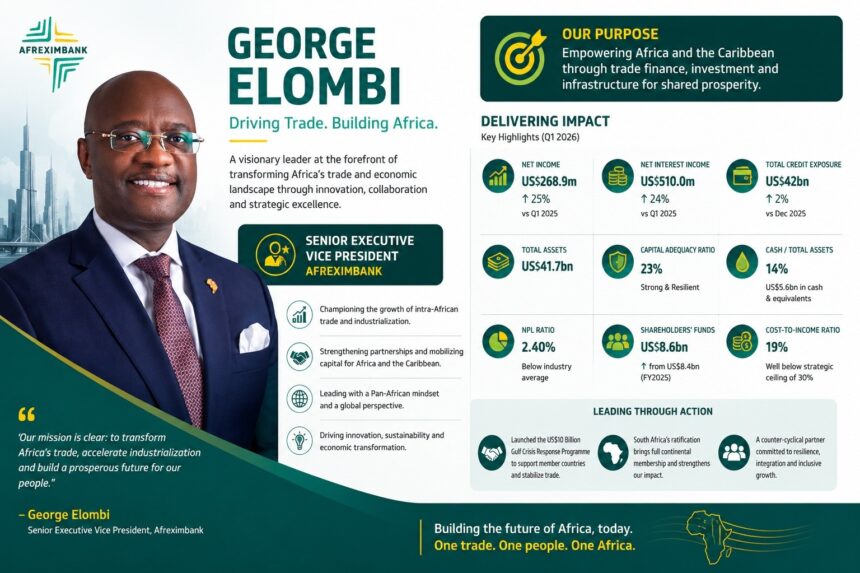
African Export-Import Bank posted a 25% rise in first-quarter net income, underscoring how demand for trade finance and crisis-response funding is helping the lender weather mounting geopolitical and economic turbulence across Africa and the Caribbean.
The Cairo-based lender, widely known as Afreximbank, said net income climbed to US$268.9 million in the three months ended March 31, from US$215.4 million a year earlier, as higher lending volumes and disciplined balance sheet management lifted profitability despite declining benchmark interest rates.
The strong earnings come at a time when African economies are grappling with tighter global financial conditions, supply chain disruptions and fallout from the escalating Gulf crisis, which threatens trade flows, energy imports and tourism revenues for several member states.
Afreximbank said gross income rose 11% year-on-year to US$874.1 million, while net interest income surged 24% to US$510 million, driven by an 8% increase in average loans and advances to US$32 billion.
The lender’s total credit exposure expanded to US$42 billion during the quarter, reinforcing its growing role as one of Africa’s most influential development finance institutions backing trade, industrialisation and infrastructure projects across the continent and the Caribbean.
Asset quality remained relatively strong, with the non-performing loan ratio holding at 2.4%, below many industry peers, even as businesses across emerging markets continue to battle currency volatility and higher debt-servicing costs.
Shareholders’ funds rose to US$8.6 billion from US$8.4 billion at the end of 2025, supported by internally generated capital and fresh equity injections from shareholders, while the bank maintained a capital adequacy ratio of 23%.
Liquidity also stayed robust, with cash and equivalents totaling US$5.6 billion, representing 14% of total assets.
The results highlight Afreximbank’s increasingly prominent counter-cyclical role during periods of global stress. In March, the bank launched a US$10 billion Gulf Crisis Response Programme aimed at cushioning member countries from economic spillovers linked to instability in the Gulf region.
The facility is expected to support governments and businesses facing pressure from rising import costs, trade disruptions and foreign exchange shortages, particularly in energy, fertilisers, aviation, food supplies and tourism.
The quarter also marked a major institutional milestone after South Africa ratified Afreximbank’s Establishment Agreement, giving the lender full continental membership coverage and strengthening its ambitions to accelerate intra-African trade under the African Continental Free Trade Area framework.
Afreximbank Senior Executive Vice President Denys Denya said the lender remained focused on stabilising trade flows and supporting economic transformation amid persistent global uncertainty.
“Against a backdrop of continued global uncertainty, heightened geopolitical risks and tight financial conditions, the Group delivered a resilient first-quarter performance,” Denya said.
The lender reported return on average equity of 13%, up from 12% a year earlier, while return on average assets improved to 2.62%.
The bank’s cost-to-income ratio edged up to 19% from 16% but remained comfortably below its long-term ceiling of 30%, reflecting continued operational efficiency even as lending activities expanded rapidly across multiple markets.