



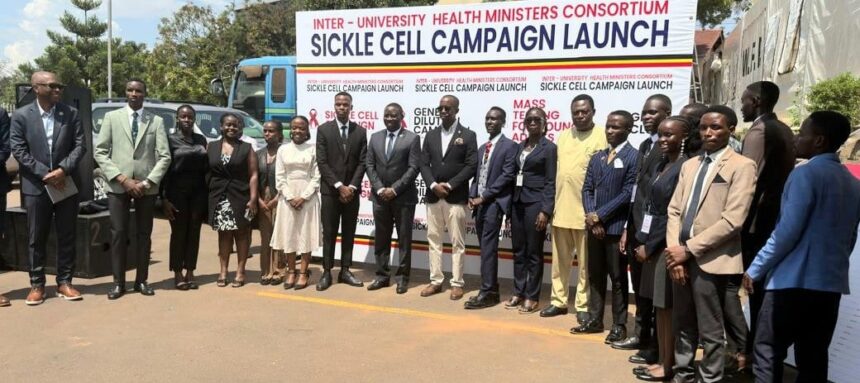
The Ministry of Health has launched a new strategy to reduce the number of children born with sickle cell disease by targeting university and tertiary institution students before they start families, shifting the country’s prevention efforts beyond newborn screening.
The initiative brings together students from 18 universities and other institutions of higher learning to promote sickle cell testing, genetic counselling and informed reproductive choices among young adults.
Launching the campaign, the Minister of State for Primary Health Care, Dr. Charles Ayume, applauded the newly formed consortium of student Ministers of Health, describing it as a critical partner in Uganda’s fight against sickle cell disease.
“Bravo to this young group of Ministers of Health from more than 40 universities and health institutions across Uganda. They seek to increase awareness of sickle cell disease, promote mass testing for young adults and champion the gene dilution campaign,” Ayume said.
He said the student-led initiative complements government investments aimed at improving both prevention and treatment of the disease, including the local manufacture of sickle cell diagnostic test kits by Microhaem, domestic production of hydroxyurea by Quality Chemicals Uganda Limited, and the recent introduction of bone marrow transplant services by the Ministry of Health.
Ayume described sickle cell disease as a public health emergency that deserves greater national attention and funding.
He welcomed the commencement of local hydroxyurea production, describing the medicine as a breakthrough in managing sickle cell complications.
“I was very happy that just three weeks ago the first batch of hydroxyurea manufactured in Uganda was launched. Hydroxyurea is a game changer in the management of sickle cell disease—not to cure it, but to significantly improve the quality of life of patients,” he said.
The minister noted that while serving as Chairperson of Parliament’s Health Committee during the 2023/24 financial year, lawmakers increased funding for hydroxyurea and directed the National Medical Stores to ring-fence the allocation to guarantee uninterrupted access.
Speaking at the campaign launch, Director General of Health Services Dr. Charles Olaro said prevention remains the most effective way to reduce the burden of the hereditary disease.
“We are hosting a number of universities and technical institutions because we want to address health issues affecting young people, particularly sickle cell disease,” Olaro said.
He noted that many students will begin raising families within the next few years, making it important for them to know their sickle cell status early.
“We want them to make informed choices through premarital counselling and testing so that when the time comes to start families, they understand their status and can help prevent children from being born with sickle cell disease,” he added.
Olaro said the campaign is also designed to educate young people on broader health challenges, including obesity, mental health, alcohol and substance abuse, HIV prevention, sexual and reproductive health, and self-care practices.
National Sickle Cell Disease Coordinator Dr. Miriam Ajambo said the campaign builds on the nationwide newborn screening programme launched by the Ministry in February but recognises that prevention must begin before couples conceive.
“Sickle cell disease comes from both parents. If two carriers have children together, there is a 25 percent chance that each pregnancy will result in a child born with the disease,” Ajambo explained.
She said Uganda continues to record more than 20,000 babies born with sickle cell disease every year, a figure the Ministry wants to reduce by encouraging young people to know their genetic status before marriage.
Ajambo revealed that she personally discovered she was a sickle cell carrier only after leaving university, an experience she does not want today’s students to repeat.
“I don’t want these young people to go through what I went through. They need to know their status now and make informed decisions,” she said.
As part of the initiative, student health ministers attending the Kampala meeting will be tested before returning to their institutions in Kabale, Mbale, Soroti, Gulu and other parts of the country. They will spearhead campus awareness campaigns and testing exercises for incoming first-year students in August.
The Ministry will provide testing materials and deploy health workers to support the exercise, with officials hoping early awareness will help students make informed relationship choices and ultimately reduce the number of Ugandan children born with sickle cell disease.