



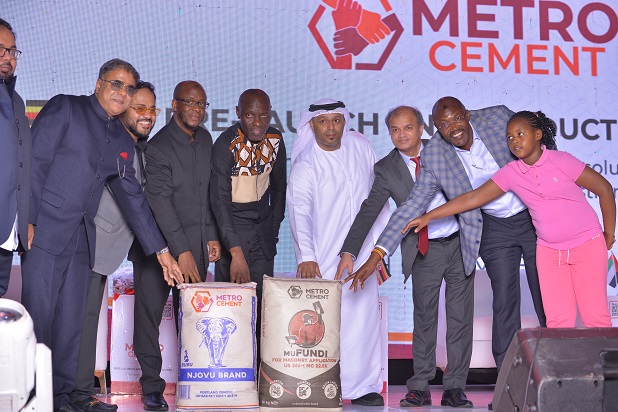
Metro Cement has pre-launched its third cement production line (Line 3) at an investor-focused ceremony in Kampala, a move that will lift the company’s total installed capacity to about 1 million tonnes per annum and strengthen Uganda’s role as a regional manufacturing and export base for East and Central Africa.
The pre-launch event, held at the Kampala Serena Hotel, comes ahead of the planned commissioning of Line 3 in the first quarter of the 2026 calendar year, within the next two to three months, once final infrastructure works are completed.
Metro Cement Chief Executive Officer Mohamed Ameer said Line 3 integrates German technology, Indian engineering and Chinese manufacturing, and has been custom-built for Ugandan raw materials and operating conditions. The line is designed to deliver higher efficiency, consistent quality and faster logistics turnaround, critical factors for serving both domestic and cross-border markets.
The new line features larger-diameter mills capable of handling higher air volumes, high-ratio gearboxes and motors, in-built dryers, and fully automated PLC and SCADA-based control systems. It also includes advanced roto-packers and a bulk cement loading system that significantly reduces truck turnaround times, supporting high-volume supply to major contractors and infrastructure projects across the region.
The expansion builds on Metro Cement’s earlier investments. The company commissioned its first modern production line in October 2020 with a capacity of 300,000 tonnes per year, followed by Line 2 in 2023, which substantially increased output and operational resilience. With Line 3, Metro Cement transitions into a large-scale regional player, aligned with rising construction demand across East Africa.
Uganda’s construction sector continues to be underpinned by strong fundamentals. The country faces a housing deficit estimated at between 2.4 and 2.6 million units, with annual demand growing by roughly 300,000 units due to population growth and rapid urbanisation.
Beyond Uganda, regional demand is being driven by public infrastructure investment, cross-border transport corridors and private real estate development in markets such as Kenya, Rwanda, South Sudan, eastern Democratic Republic of Congo and northern Tanzania.
Founded in 2019 on the site of a former factory in Mbale, Metro Cement has grown from a start-up operation into an integrated manufacturer with more than 100 direct employees and over 300 indirect livelihoods supported through its value chain.
The company has also invested in local infrastructure, community development and skills transfer, strengthening its social licence to operate.
Line 3 introduces advanced process technology focused on energy efficiency and environmental compliance. The plant incorporates a high-efficiency grading and classification system that improves particle size distribution, enhances moisture removal and lowers energy consumption, while embedding emissions-control systems that align with national and international environmental standards.
As part of the expansion, Metro Cement is launching three new cement products, including Farasi 32.5R/72, engineered for block-making to support faster, stronger and more durable construction. The wider product mix is aimed at improving affordability through scale while meeting diverse technical requirements across different regional markets.
Government agencies signalled strong support for the investment. Uganda Investment Authority Director General Robert Mukiza said Uganda is positioning itself as an anchor manufacturing location for investors seeking access to East Africa’s more than 300 million consumers and the wider COMESA market of about 600 million people, supported by preferential trade arrangements.
He cited Uganda’s political stability, improving infrastructure, investment incentives and full profit repatriation as key factors for long-term industrial investors. Mukiza encouraged manufacturers to consolidate capacity in Uganda and serve regional markets through exports rather than replicating plants in multiple countries.
National Environment Management Authority Executive Director Dr Barirenga Akankwasah said the authority would continue working with industrial investors to ensure sustainable manufacturing, particularly in energy- and resource-intensive sectors such as cement.
Metro Cement said the Line 3 investment has been financed through private equity without bank debt, reflecting long-term confidence in Uganda’s macroeconomic stability and regional growth prospects.
Once commissioned in early 2026, Line 3 is expected to strengthen local supply, reduce reliance on imports and support large-scale infrastructure projects across East and Central Africa.
For regional and pan-African investors, the project is indicative of a broader shift toward building scale manufacturing capacity in strategically located markets capable of serving multiple countries from a single production base.