



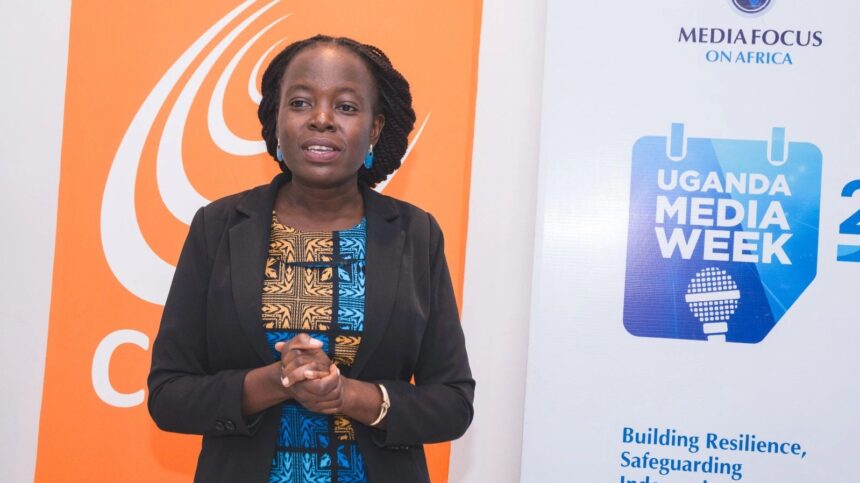
Uganda Media Week has emerged as a critical platform for journalists and media stakeholders to confront challenges facing the industry, share solutions and chart a collective way forward, according to Jan Ajwang, Projects Manager at Media Focus Africa.
Speaking on the purpose and impact of the annual gathering, Ajwang said Uganda Media Week provides a rare opportunity for journalists to meet “by us, with us,” allowing media professionals to reflect on their work beyond the routine of covering events and reporting on others.
“The media, as the fourth estate, has a critical role in our democracy,” Ajwang said, noting that journalists inform the public, educate communities and hold those in power accountable.
“For many people, what they know about the world comes from the media, which makes journalism essential to the existence of a country.”
Ajwang observed that while other professions regularly convene to plan and strengthen their sectors, journalists often lack spaces to openly discuss their own challenges.
Uganda Media Week, she said, fills that gap by building confidence and solidarity among media practitioners, helping them realise that many of their struggles are shared.
Over the past seven years, she noted, the platform has delivered tangible results. Journalists have pursued further training to professionalise their work, media managers have explored new revenue streams, and newsrooms have adopted innovative business and content strategies inspired by discussions during the week.
Ajwang highlighted progress on gender representation in the media, describing a shift from questioning the relevance of women’s issues to the establishment of gender desks and attracting advertisers interested in supporting gender-focused content.
“The point is not just to talk, but to convert talk into action,” she said, adding that ideas shared during sessions are increasingly being replicated in newsrooms across the country.
She also emphasized the importance of inclusive dialogue, noting the participation of government agencies, civil society, technology companies, content creators and bloggers.
However, Ajwang emphasized that ethical standards must be upheld by all, not only formally trained journalists.
“Our responsibility is not just to ourselves, but to future generations,” she said. “We chose the media, and we must do our best to shape the future of journalism in this country.”