



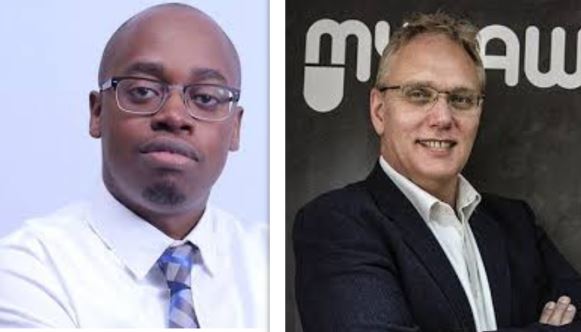
In 2012, a group of young Ugandan healthcare professionals saw a problem many others had missed: the way healthcare was delivered in much of Africa was inefficient, inaccessible, and painfully fragmented.
Long lines, overcrowded facilities and a chronic shortage of doctors — Uganda had one of the world’s lowest doctor‑to‑patient ratios — made remote care not a luxury, but a necessity.
Out of this frustration, and driven by a belief that mobile technology could bridge the gap between providers and patients, five co‑founders — led by medical doctor Dr. Davis Musinguzi — launched what would become one of the most talked‑about digital health ventures in East Africa.
The company, initially known as The Medical Concierge Group, bundled teleconsultations, laboratory services and medicine delivery into a single platform under the brand Rocket Health.
Rocket Health’s early model was simple and compelling: use phones — even basic USSD or WhatsApp — to connect patients with doctors, courier lab sample pickups to patients’ homes, and deliver prescriptions directly to their doors.
For a population where rural access to specialists was nearly nonexistent and traditional clinics were a logistical burden, this was transformational.
Partnerships helped Rocket Health scale quickly. By 2020, the company was providing telemedicine access to insurance networks, including UAP Old Mutual members, enabling 24/7 doctor consultations, home lab tests and doorstep deliveries — all coordinated through digital channels.
The Sweet Spot of COVID,and Venture Capital’s Arrival.
Then came COVID‑19. The pandemic dramatically accelerated demand for remote healthcare everywhere, and Rocket Health was perfectly positioned to benefit. Consultations jumped exponentially, with some reports indicating growth of more than 400 % year‑over‑year, and the company rapidly expanded its user base, facilities and service offerings.
That momentum caught the attention of institutional investors. In March 2022, Rocket Health closed a US $5 million Series A funding round led by Creadev Africa, and supported by Grenfell Holdings and LoftyInc Capital Management — bringing total capital raised to around US $6.2 million.
For a decade‑old Ugandan startup, this was a major milestone. In many African health‑tech narratives, securing seven‑figure funding signals both a validation of the business model and a launchpad for regional expansion. Rocket Health’s investors were explicit: the funds would help scale services across East Africa and pursue long‑term regional growth ambitions.
From Growth to Fracture-Governance Tensions Emerge
But venture capital comes with expectations. Institutional investors weren’t simply writing a cheque — they wanted governance, transparency, benchmarks, and a path to sustainable scale, preferably beyond Uganda.
As Rocket Health accelerated operations, its burn rate began to climb. Faster hiring, expanded infrastructure, deepening service offerings, and ambitious regional plans strained cash flows. According to insiders, operating expenses outpaced revenue, and the runway began to shrink.
These pressures exposed a core tension: the founders — particularly Dr. Musinguzi — were deeply attached to their original vision and leadership role, while investors were pushing for a more formal governance structure with clear performance metrics and professional management. As Rocket Health negotiated this transition from founder‑led startup to investor‑guided growth company, the internal dynamics grew increasingly fraught.
By mid‑2024, as part of the broader restructuring of the business, investors pursued a strategic merger with My Dawa Holding Company Limited, a Kenyan digital health and e‑pharmacy platform seeking broader East African reach.
MyDawa’s model — combining an extensive physical pharmacy network with digital healthcare services — represented a stabilizing force for Rocket Health’s future, but it also fundamentally shifted the company’s identity and control structure.
Under the share‑swap arrangement connected with the merger, Rocket Health’s institutional investors agreed to exchange their equity for stakes in the enlarged MyDawa entity. In August 2024, Dr. Musinguzi was removed from his role as CEO, replaced by new management — an unequivocal end to founder control.
A One-Share Governance Crisis and Legal Stand-Off
Although MyDawa had effectively taken financial and strategic control of the merged entity, it was still necessary to implement the agreed corporate resolutions under Ugandan law — a process that hit an unexpected snag. The operating company’s share structure was unusual: Rocket Health Africa Corporation held 199,999 shares, and Dr. Musinguzi held just one share. Under the company’s articles, at least two shareholders were required to form a quorum at a members’ meeting.
Dr. Musinguzi’s refusal to participate in meetings following his ouster effectively paralyzed the company’s governance, blocking approvals for share transfers, changes in directorship, and the formal winding up of the majority shareholder.
Medical Concierge Group petitioned the Ugandan High Court, arguing that this was not a legitimate exercise of minority protections but a deliberate attempt to hold the company hostage.
Dr. Musinguzi’s legal team sought instead to channel disputes into arbitration in London, based on clauses in the share swap agreement and argued that he was entitled to about US $100,000 for his single share under that deal.
In March 2026, Justice Isaac Teko delivered a decisive ruling. The judge acknowledged the arbitration clause, but noted that Medical Concierge Group was not a party to the share swap agreement and therefore could not be bound by it.
More critically, he held that Dr. Musinguzi’s refusal to allow meetings to proceed constituted an abuse of the company’s governance mechanisms — effectively denying the company its ability to operate and make legally required decisions.
“In the matter of Medical Concierge Group Ltd & Rocket Health Africa Corporation (Company Cause 20 of 2025) [2026] UGHCCD 47 (3 March 2026) Court ordered a members’ meeting under Companies Act s 138, holding arbitration clause between other parties did not oust jurisdiction”, the judge ruled.
Applying corporate law provisions that allow the High Court to intervene when it is “impracticable” to convene meetings under a company’s articles, Justice Teko authorised Medical Concierge Group to convene and hold a members’ meeting with Rocket Health Africa Corporation alone constituting quorum.
This resolved the immediate governance deadlock and cleared the way for the implementation of the share transfers, director changes and winding‑up processes that had been stalled for over a year.
Lessons in Corporate Growth,Governance and Founder Dynamics
Rocket Health’s journey — from local telemedicine hopeful to a component of a larger East African healthcare platform — reflects both the promise and peril of scaling tech ventures in Africa. Its early success demonstrates the power of digital innovation to reshape essential services.
Its later struggles highlight familiar themes: the tension between founders and investors, the importance of governance structures that anticipate minority leverage, and the legal complexities that can arise when strategic restructuring intersects with personal claims and corporate rules.
For the region’s growing startup ecosystem, the saga offers hard‑won lessons: venture capital brings both opportunity and obligation, and without clarity in governance and escalation pathways, even companies with massive potential can fall into gridlock.
Whether as a cautionary tale or a case study in resilience, the Medical Concierge Group and Rocket Health episode will likely be studied by entrepreneurs, investors and legal practitioners across Africa’s burgeoning innovation economy.