



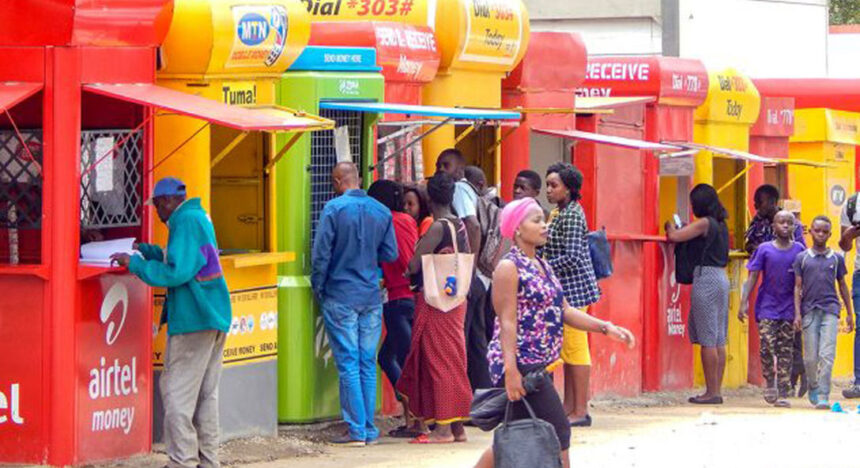
Sarah Nakato wakes up every morning in Kalerwe market, arranges her tomatoes, onions, and greens, and opens her phone. For her, mobile money isn’t some fancy app — it’s her bank, her accountant, her lifeline. Customers pay her through it. She sends money to suppliers upcountry. She even saves small amounts for her children’s school fees on her phone.
But every single time she withdraws that money to actually use it, the government takes 0.5%. It looks small on paper. In real life, it adds up fast.
“I may delay taking out my money just because of the charges,” Sarah says, her voice tired but calm. “It may look small, but when you do it many times a day, it becomes a lot.”
Sarah’s story is the story of millions of ordinary Ugandans right now.
Uganda has one of the busiest mobile money systems in Africa. Billions of transactions happen every year. For many people — especially those running small businesses, market vendors, boda riders, and village traders — it’s the only safe and easy way to handle money.
But the government has decided to keep the tax on withdrawals, saying the country needs every shilling to pay for roads, schools, and hospitals.
Ministry officials argue they have to balance the books. Ramathan Ggoobi, the Permanent Secretary and Secretary to the Treasure recently said the government must find ways to raise money locally while still encouraging people to use digital money.
Ggoobi recently confirmed that the proposed reduction of the tax would not be implemented in the upcoming financial year, signalling government’s reluctance to ease pressure on one of its more reliable revenue streams, “…. is not part of the upcoming financial year’s revenue measures”, he said.
They’re not wrong about needing revenue — Uganda has debts to manage.
Uganda Revenue Authority officials have also defended the tax, noting that consumption-based levies on digital transactions are easier to administer in a largely informal economy.
Commissioner General of the Uganda Revenue Authority, John Musinguzi Rujoki, says mobile money provides “a visible and trackable platform for revenue collection,” especially where traditional tax systems struggle to capture small and informal taxpayers who were previously outside the tax net.
But here’s where it hurts: this tax hits the poorest the hardest.
Researchers at the Economic Policy Research Centre point out that taxing withdrawals is basically taxing people’s access to their own money. Poor people don’t move millions in one go. They do many small transactions. That means they pay the tax more often. It’s what economists call a regressive tax — the smaller your income, the heavier it feels.
For small business owners, it’s even more painful. Mobile money helped them move away from risky cash handling. Now some are thinking twice before using it, or going back to carrying cash. That’s dangerous, slow, and exactly the opposite of the “digital Uganda” the country wants to build.
Even the big telecom companies like MTN and Airtel are worried, though they speak carefully. Lower usage means less business for them, for their agents, and for the whole fintech world that’s been growing.
And don’t forget the mobile money agents themselves — those young men and women sitting under umbrellas in every trading centre. Their daily bread depends on the number of people who come to withdraw or send money. When customers start avoiding withdrawals, their own small income also dries up.
This isn’t just about numbers and policy papers anymore. It’s about whether the push to raise money is making life harder for the very people who keep the economy moving every single day — the Sarah Nakatos of Uganda.
She’s not against paying tax. None of them are.
“We are not refusing to pay tax,” Sarah says. “But it should not make doing business harder.”
As Uganda dreams of becoming a modern, cashless economy, this small 0.5% tax has turned into a big test: Can we grow our revenue without stepping on the necks of the people trying to survive and build something?
For now, many ordinary Ugandans are feeling the weight of that question in their pockets every single day.