



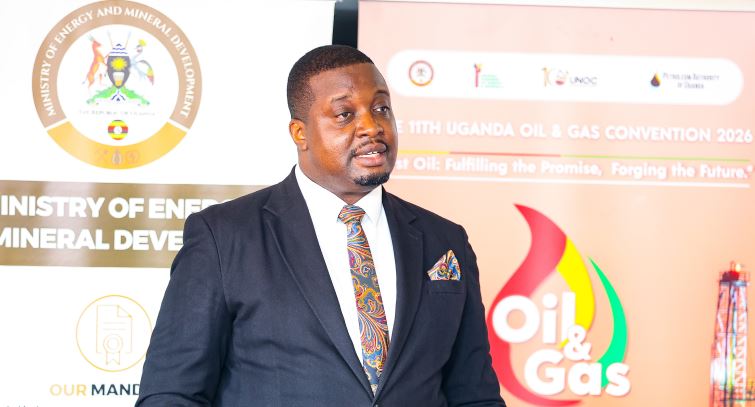
Uganda’s long-awaited entry into commercial oil production is edging closer, with government and industry players pointing to major milestones achieved across key upstream and midstream projects ahead of first oil expected in 2026.
Officials from the Ministry of Energy and Mineral Development, Petroleum Authority of Uganda, Uganda National Oil Company and the Uganda Chamber of Energy and Minerals say progress recorded under the ongoing 30-day oil and gas media campaign confirms the country is in its “final countdown” to production.
“The government has maintained a clear and consistent position, we will achieve First Oil in the second half of 2026. What we are seeing across project sites reflects coordinated national effort, political will, and institutional discipline,” said Mr. Humphrey Asiimwe Chief Executive Officer at the Uganda Chamber of Energy and Minerals.
The campaign, themed “Fulfilling Uganda’s First Oil Promise,” has served as a national platform to assess readiness across government, private sector and local communities.
Flagship upstream projects—Tilenga and Kingfisher—have made significant strides. Tilenga has completed 198 wells, exceeding the 170 required for first oil, while Kingfisher has drilled 21 wells, surpassing its 19-well target. Meanwhile, the East African Crude Oil Pipeline (EACOP), a critical export route, is now about 83 percent complete, with compensation to affected communities nearing full settlement.
Authorities say these developments place Uganda firmly on track to deliver first oil within 2026, even though an exact date remains unspecified.
Ms. Gloria Sebikari ,Manager of Corporate Affairs and Public Relations at PAU, said, “We are beyond the question of whether Uganda can produce oil. The wells are drilled, the targets are met, and contractors are working around the clock.”
With estimated recoverable reserves of 1.6 billion barrels and projected peak production of 190,000 barrels per day, Uganda is positioning itself as an emerging energy player in the region. Beyond production, the sector is already reshaping the economy.
More than $2.3 billion worth of contracts have been awarded to Ugandan companies, supporting over 21,000 direct jobs and tens of thousands more indirectly. The push for local content has also driven technology transfer and skills development, with institutions such as the Uganda Petroleum Institute Kigumba training workers for the next phase.
As the country transitions into operations, expected to span 20 to 30 years, opportunities are shifting toward maintenance, logistics, digital systems and equipment supply. Ugandan firms are already leveraging their experience to compete in regional markets including Tanzania, Mozambique and Namibia.
Industry players note that infrastructure development—ranging from heavy-lift cranes to advanced transport systems—signals broader industrial growth tied to the oil sector.
However, challenges remain, including global supply chain disruptions and rising costs linked to geopolitical tensions.
Attention now turns to the 11th Annual Oil and Gas Convention scheduled for April 28–29 at Speke Resort Munyonyo, where stakeholders will assess readiness for production and map out strategies for long-term value creation in Uganda’s petroleum industry.