



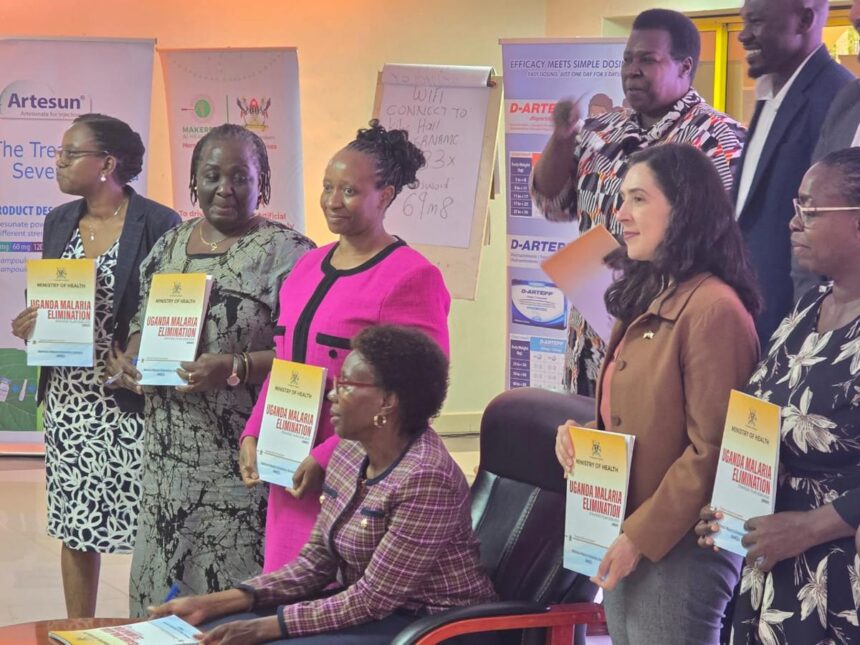
Uganda has launched its 2026–2027 Malaria Elimination Strategy, setting a clear path toward a malaria-free country and shifting the national focus from control to complete eradication of the disease.
Unveiled under the theme “Advancing for a Malaria-Free Uganda that Drives Socio-Economic Growth and National Development,” the strategy emphasizes coordinated action across communities, health systems, and government institutions.
Health Minister Dr. Jane Ruth Aceng stressed that eliminating malaria will require intensified public awareness and grassroots engagement.
“If we educate our communities and empower Village Health Teams to move door-to-door with testing, treatment, and referrals, we can achieve zero malaria deaths by 2030,” one senior official said.
The strategy targets a 75 percent reduction in malaria incidence, with at least 19 districts expected to reach pre-elimination status. Authorities say the plan is data-driven and aligned with national development priorities, positioning malaria elimination as both a health and economic goal.
A key component of the strategy is the integration of malaria vaccination into routine immunization systems.
Sylvia Atugonza-Deputy Program Manager, Vaccines and Immunization – Ministry of Health said, “the integration of malaria and immunization platforms has been critical in generating demand and ensuring health workers are able to deliver the vaccine effectively”.
Uganda’s malaria vaccination programme, launched in April 2025, has so far administered more than 3.1 million doses across 107 districts. However, officials raised concern over low completion rates for the four-dose regimen.
“You can only achieve full protection when all four doses are completed. We are seeing strong uptake for the first dose, but drop-offs in subsequent doses must be addressed,” Aceng said, urging communities to ensure children complete the schedule.
A post-introduction evaluation conducted with support from the World Health Organization identified gaps in health worker training and data management. “We found that some vaccinations were not being recorded, which affects national coverage data. We are now transitioning to digital systems to fix this,” Atugonza explained.
Officials also highlighted funding challenges, warning that reduced support from partners such as Gavi could affect vaccine access. “Government is stepping in to bridge the gap because every child must be protected,” noted Aceng.
Experts further cautioned that Uganda’s climate—characterized by high temperatures, humidity, and frequent rainfall—creates ideal conditions for year-round malaria transmission.
“The environment is actually in favour of malaria. That is why elimination is not easy and requires sustained effort,” Mansour Ranjbar, a Tropical and Vector-Borne Diseases Multi-country expert remarked.
Authorities are now calling on all Ugandans to take personal responsibility in the fight. “Talk about malaria everywhere—at home, in communities, even during football matches. Remind each other to vaccinate children and seek treatment early,” Aceng urged.
With strong political backing, including commitments from Parliament to mobilize resources, officials say Uganda is positioned to make significant progress—if collective action is sustained.