



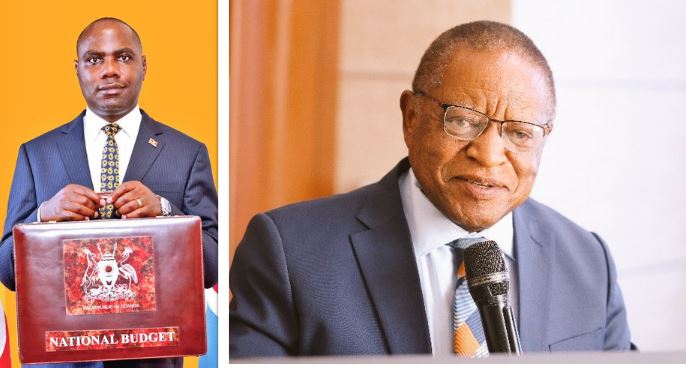
Uganda has unveiled a record Shs84.3 trillion budget for the 2026/27 financial year, promising to accelerate commercial agriculture, industrialisation, digital transformation and market expansion.
Yet behind the ambitious growth agenda lies a more difficult question confronting policymakers: can the country sustain its development ambitions while public debt continues to climb at an unprecedented pace?
The spending plan, aligned with the Fourth National Development Plan and the government’s Tenfold Growth Strategy, places wealth creation and the “full monetisation of Uganda’s economy” at its core.
More than half of the budget will be financed through domestic revenues as government seeks to raise an additional Shs1.7 trillion through tax measures and stronger revenue mobilisation.
But the optimism surrounding the budget is tempered by a growing fiscal burden that former Finance Minister Dr. Ezra Suruma believes can no longer be ignored.
Uganda’s public debt has now ballooned to approximately Shs130 trillion, crossing the International Monetary Fund’s 50 percent debt-to-GDP sustainability benchmark and intensifying concerns about the country’s long-term fiscal trajectory.
Suruma, one of the principal architects of Uganda’s economic reforms, argues that the country’s greatest challenge is no longer development spending itself but the gradual erosion of fiscal discipline.
He recalls an era when government strictly adhered to spending within approved budgets, warning that the increasing reliance on supplementary expenditures has weakened confidence in the budget process.
“You can’t be having an emergency every month,” Suruma argues, describing the recurring supplementary budgets as evidence of structural weaknesses rather than unforeseen crises.
The FY2026/27 budget allocates substantial resources to human capital development, infrastructure, security and debt servicing, with human capital receiving roughly Shs13.5 trillion, infrastructure Shs10.8 trillion and security Shs10.2 trillion. Debt obligations continue to consume a significant share of public resources, limiting fiscal flexibility.
Analysts note that the burden could become heavier if global fuel prices remain elevated or external economic shocks intensify.
Government is banking on stronger domestic revenue mobilisation to ease borrowing pressures, with revenue-to-GDP currently standing at about 15.3 percent and a target of 18 percent by 2030.
Suruma, however, cautions against relying heavily on fuel taxation, arguing that transport costs feed directly into the prices of nearly every commodity and service in the economy, amplifying inflationary pressures on households and businesses alike.
He is equally critical of Uganda’s investment priorities in agriculture, noting that budget allocations remain well below continental commitments despite the sector employing the majority of the population.
Rather than focusing solely on production, Suruma believes investments in rural storage infrastructure could significantly reduce post-harvest losses and stabilise farmer incomes by preventing distress sales when prices collapse.
The prospect of future oil revenues offers government additional fiscal room, but civil society organisations warn that debt servicing and long-term infrastructure commitments could continue to absorb much of the country’s expanding resource envelope.
Nevertheless, to investors and businesses, the 2026/27 budget presents a picture of competing realities of an economy pursuing rapid structural transformation while simultaneously confronting mounting debt obligations, rising financing costs and persistent questions over fiscal discipline.
Whether Uganda’s ambitious growth strategy delivers broad-based prosperity may ultimately depend less on the size of its budget than on its ability to restore spending discipline, strengthen domestic revenue collection and ensure borrowed resources generate sustainable economic returns.