



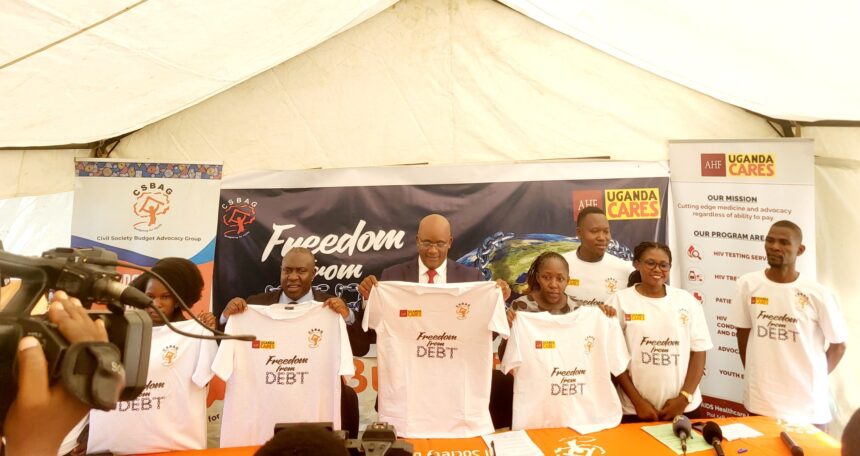
Civil society organizations have launched a nationwide campaign demanding greater transparency, accountability, and fairness in public debt management, warning that Uganda’s growing debt burden is increasingly threatening investments in healthcare, education, agriculture, and future economic growth.
The Freedom from Debt Campaign, unveiled in Kampala by the Civil Society Budget Advocacy Group (CSBAG) in partnership with AHF Uganda Cares, seeks to rally citizens, policymakers, and international stakeholders around debt justice and sustainable public financing.
According to campaign organisers, Uganda’s public debt is projected to reach Shs130 trillion in FY2026/27, while debt servicing obligations are expected to exceed Shs33.6 trillion, significantly outpacing allocations to several critical sectors.
Speaking at the launch, Julius Mukunda, Executive Director of CSBAG, acknowledged that borrowing remains necessary for Uganda’s development ambitions but stressed that the country must address inefficiencies in revenue collection and public investment management.
Mukunda noted that Uganda’s tax-to-GDP ratio remains between 13 and 15 percent, well below levels required to finance the government’s ambitious tenfold economic growth strategy, the Fourth National Development Plan (NDP IV), and long-term development objectives.
“Our tax revenues are simply too low to finance all the investments the country requires,” Mukunda said. “Even if Uganda Revenue Authority collected all projected revenues without leakages, the resources would still not be sufficient to fund our development agenda.”
He argued that while public debt remains an important financing tool, Uganda must ensure borrowed funds generate value through well-prepared and efficiently implemented projects.
Citing findings from the Auditor General, Naiga Peninah from the Uganda Debt Network said only 66 percent of projects included in Uganda’s Public Investment Plan had undergone feasibility studies by 2021, contributing to costly delays and overruns.
He pointed to major infrastructure projects such as the Karuma Hydropower Dam and the Sseguku–Mpigi Highway, where implementation delays have increased costs while reducing expected economic returns.
The challenge has been compounded by Uganda’s increasing reliance on non-concessional borrowing, which carries shorter repayment periods and higher interest rates.
“In many cases, government starts repaying loans before projects are completed and before they begin generating economic returns,” Naiga said.
The campaign is also advocating reforms to the global financial system, which organisers argue unfairly disadvantages developing countries.
However, some of the strongest criticism of the global financial system came from Henry Magala, Country Programme Director of AHF Uganda Cares, who described the existing international debt architecture as fundamentally unfair to developing countries.
“When you look at these debts, you find that private creditors account for nearly 50 percent of public external debt for many countries,” Magala said. “Once you are dealing with the private sector, you know that the terms are not the best. That is why we need to look at the bigger picture.”
Magala questioned why countries like Uganda should pay borrowing costs significantly higher than those enjoyed by wealthy economies.
“Why should Uganda pay about 10 percent interest compared to countries like the United States or Germany?” he asked. “There is obvious unfairness in the current system.”
He also highlighted the enormous burden debt servicing places on poorer countries, saying billions of dollars are effectively transferred annually to creditors instead of supporting development priorities.
“When you look at debt servicing, poor countries are forced to pay enormous amounts every year. That situation has to be restructured because it continues to undermine investments in essential public services,” he said.
Magala threw his support behind proposals for the establishment of a Borrowers’ Forum, arguing that developing countries would be better positioned to negotiate collectively rather than individually.
“Right now countries negotiate one by one, but if we come together through a Borrowers’ Forum, it becomes possible to share experiences, understand the challenges we face, and negotiate from a stronger position,” he said.
According to Magala, such a platform would also enable countries to collectively advocate for fairer lending terms, debt-for-development swaps, and reforms in international debt governance.
To address these challenges, the campaign is calling for the creation of an international Borrowers’ Forum, where developing countries can collectively negotiate debt terms, share experiences, and push for reforms in global debt governance.
“Through one united voice, we can negotiate for fairer terms and pursue debt-for-development swaps that can redirect resources towards social priorities instead of excessive debt servicing,” he said.
He further argued that the proposed forum should be formally institutionalised and recognised by major international financial institutions.
“We should be engaging institutions like the IMF and the World Bank so that this forum becomes institutionalised and has a recognised voice when debt terms are being negotiated,” Magala said.
Beyond negotiations, he stressed that accountability for borrowed resources remains equally important.
The initiative is also advocating for automatic debt-service suspensions during public health emergencies and climate-related disasters, as well as debt-for-development swaps that redirect repayments toward essential public services.
Representatives from SEATINI Uganda, including Hilda Tumuhe, warned that rising debt servicing costs are crowding out investments in health, education, and industrialisation while increasing risks for future generations.
Tumuhe said refinancing and rollover obligations continue to grow annually, creating a situation where debt burdens are merely postponed rather than reduced.
“The youth who make up the majority of Uganda’s population will ultimately inherit these obligations,” she said.
The campaign additionally highlighted concerns over corruption, weak procurement systems, project delays, and inadequate citizen participation in debt-financed projects, arguing that such weaknesses undermine returns on public investments.
Campaign organisers are now calling on government to review tax exemptions, strengthen domestic revenue mobilisation, improve public investment management, and ensure greater public scrutiny of borrowing decisions.
They maintain that debt should remain a tool for development rather than becoming a burden that compromises future prosperity.