



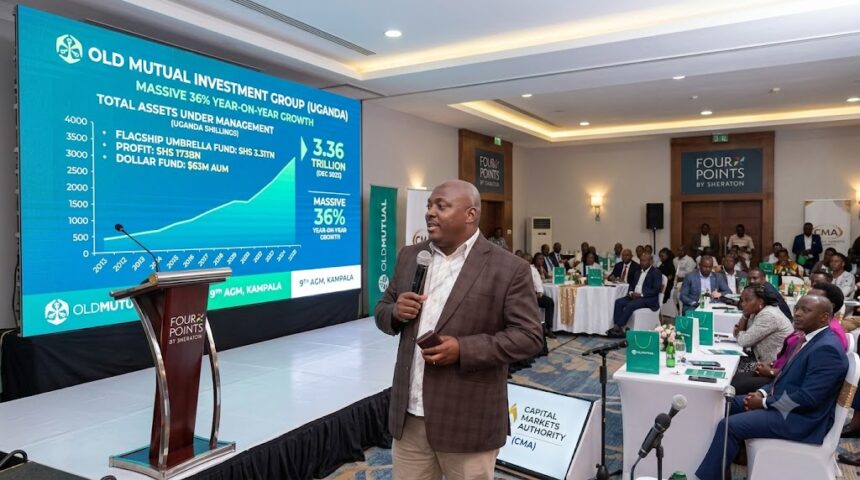
Old Mutual Investment Group’s unit trusts have surged to a record Shs 3.36 trillion (about $900 million) in assets under management for the year ended December 2025, solidifying its dominant position in Uganda’s rapidly expanding asset management industry.
The financial services giant recorded a staggering 36% year-on-year growth from Shs 2.46 trillion in 2024, a performance driven by a combination of aggressive domestic savings mobilisation and attractive yields on government debt.
Speaking at the company’s 9th annual general meeting at the Four Points by Sheraton Hotel in Kampala, Chief Financial Officer John Golooba attributed the massive expansion to strong net inflows, rising retail investor participation, and the compounding effect of reinvested income across its portfolio.
The bulk of the group’s capital remains heavily anchored in the domestic fixed-income market.
Golooba revealed that Shs 2.61 trillion, representing nearly 79% of total assets, is invested in Ugandan government securities, which continue to offer compelling risk-adjusted returns amid tighter regional monetary conditions.
An additional Shs 675 billion has been deployed into high-yield commercial bank deposits to maintain liquidity.
The group’s flagship Umbrella Trust Fund remained the primary engine of growth, expanding 34.4% to account for Shs 3.31 trillion of the total asset base.
The fund generated Shs 255 billion in investment income and posted a net profit of Shs 173 billion.
Meanwhile, its dollar-denominated fund delivered an even more explosive trajectory, swelling 61.2% to $63 million. The dollar fund’s total income doubled to $3.22 million, yielding a net profit of $2.34 million, as affluent savers sought a hedge against currency volatility.
The rapid institutional growth comes amid a broader shift in Uganda’s financial landscape, where a legacy of banking sector scepticism and fraudulent investment scams is giving way to regulated, technology-driven asset pools.
Managing Director Zac Kisesi noted that a coordinated financial literacy push by both fund managers and the Capital Markets Authority has successfully diverted capital away from informal schemes and into regulated collective investment vehicles.
Kisesi highlighted a structural shift in how Ugandans manage capital, pointing to a surge in formal corporate treasury accounts, investment clubs, and community-led savings groups leveraging institutional asset management to protect against inflation.
He added that digital innovation has dismantled traditional barriers to entry, with clients now using mobile-accessible portals to track portfolio balances in real-time and execute rapid redemptions, a level of transparency that has fundamentally transformed retail investing in East Africa.