



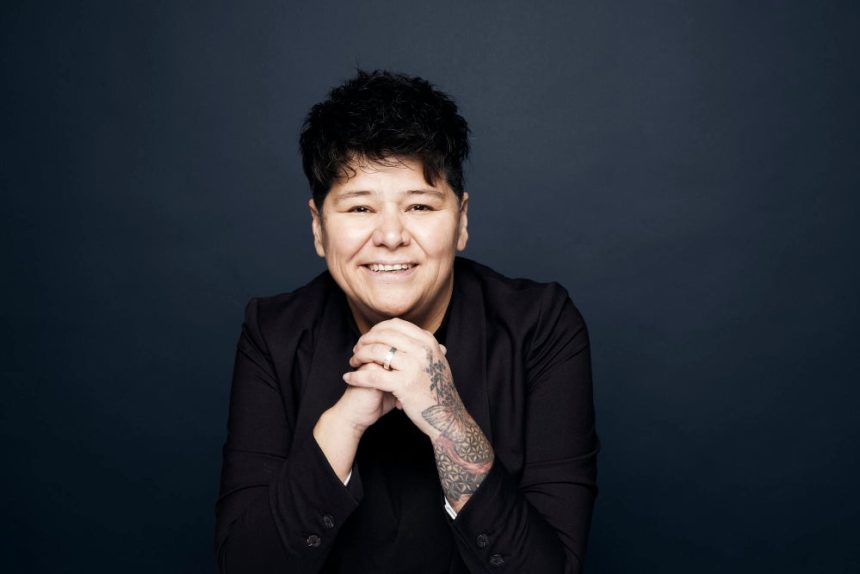
Bobbie Racette, founder and CEO of virtual assistance company at Virtual Gurus didn’t always have a clear sense of how her story would unfold. She didn’t necessarily envision a chapter on becoming an entrepreneur- but it would turn out to be one of the most important ones.
Before Racette started her business she says she had little direction and “was kind of just one of those people who went from job to job looking for different things to do.” In 2015, Racette was working as a safety technician in Calgary’s oil and gas industry when lay-offs struck. she lost her job and struggled to land her next role.
“I couldn’t get a job no matter how many resumes I sent out,” Racette recalls. Interviews after interviews And nobody would hire me.” Racette lived in a conservative area and says that her identity as a queer, Indigenous woman with tattoos may have hindered her search.
Ultimately, after being inundated with posts about the freelancer gig economy, she decided to try it out for herself: She created an Upwork profile offering her services as a virtual assistant. That, too, was difficult. Most of her competitors were in other countries, so she had to bid as little as $2 to secure jobs on the platform. Racette knew there had to be a better way.
So, despite not knowing “anything about running a business” Racette resolved to start her own. She set out to build a gig work platform that would connect virtual assistants with companies in need of help with a range of tasks, from bookkeeping to customer support and officially launched in 2016.
Racette’s long-term goal was to provide quality work-from-home opportunities for other people from marginalized and underserved communities.
In the early days, when Virtual Gurus was a one-woman show, the market need for the platform was clear: The business Racette launched with just $300 to her name saw $300,000 in revenue in year one.
By the second year, Racette still hadn’t hired her first employee and although she continued to make money, she worked “around the clock.” She needed to raise funds and assemble her team.
It took 170 investors saying “no” to Virtual Gurus before Racette got her first “yes,” but the business secured an $8.4 million funding in the first round and has since grown beyond a $50 million valuation, per the company.
Racette’s first hire was a single stay-at-home mom, and by 2020, she’d expanded to a team of more than 40. Today, Virtual Gurus has provided work for more than 2,000 people in Canada and the U.S. — and counting.
Virtual Gurus is on a mission to disrupt the virtual assistant market through curated matches and a talent marketplace that focuses on employing historically underrepresented individuals, according to Racette.
The Series A capital, which includes $5.4 million in equity with the remainder in non-dilutive capital, follows a busy few years for Virtual Gurus. Racette bootstrapped her company for around three years before securing $1.2 million in initial financing in early 2020, followed by more than $ 1.7million a year later.
The startup’s total equity financing to date is $10.4 million. In that time, Racette says Virtual Gurus has seen significant growth, with a 129 percent year-over-year increase in revenue.
“That is thanks to the pandemic, because where companies were laying people off we realized that fractional EAs [executive assistants] were perfect for them,” said Racette. “Whereas on the other side, we were able to pick up all of the administrative staff that were getting laid off.”
Source:Betakit & Entreprenuer