



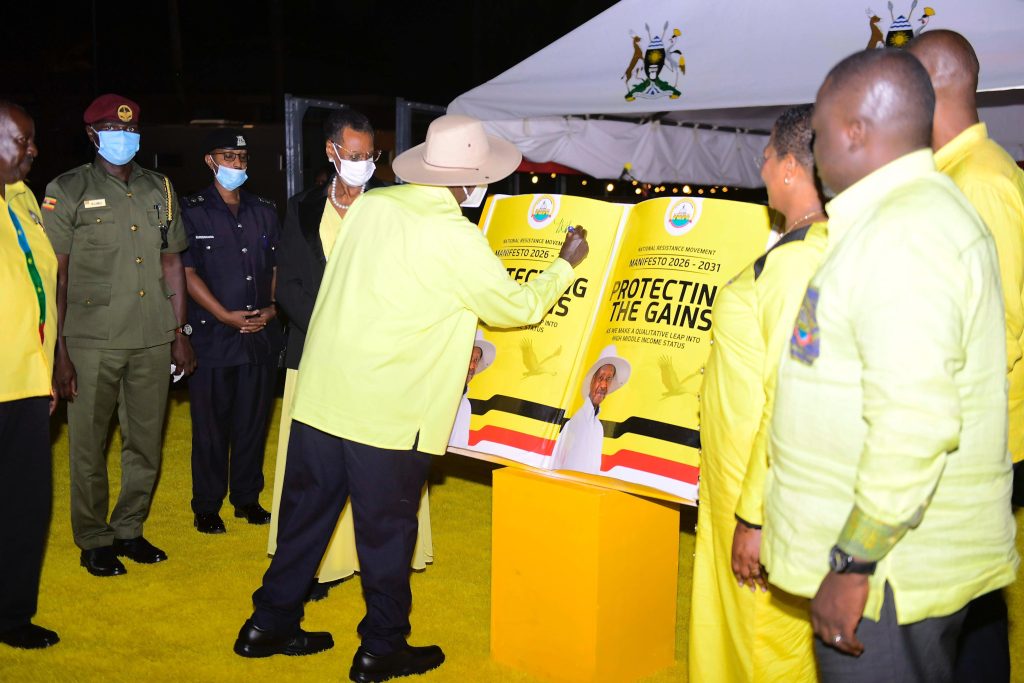
As Uganda heads toward its next political cycle, the ruling National Resistance Movement (NRM) has unveiled a manifesto that re-casts President Yoweri Museveni’s long-standing economic vision into a sharper, more industrial-driven roadmap. The 2026–2031 document pledges to push the country “into high middle-income status,” expand GDP toward the USD 500 billion mark by 2040, and transition millions of households from subsistence to commercial production.
At its core, the manifesto rests on nine economic pillars: commercializing agriculture, scaling value-addition, industrializing through Special Economic Zones, expanding infrastructure, deepening access to affordable finance, boosting human capital, and unlocking regional markets under the East African Community and AfCFTA frameworks.
The Promise of Transformation
The document’s economic chapter paints an optimistic picture of continuity and ambition. Building on previous manifestos, it promises an integrated industrial base supported by strong transport and energy networks. There is renewed commitment to expanding the Uganda Development Bank’s lending portfolio, supporting small and medium-sized enterprises (SMEs), and strengthening SACCOs as community financing engines.
Equally, the NRM is betting heavily on agro-industrialisation — encouraging farmers to move up the value chain in coffee, cotton, tea, fruits, and fish. The manifesto also positions digital transformation and fintech as new frontiers for productivity and inclusion.
Risks on the Road to 2040
Yet analysts warn that the plan’s ambition outpaces the state’s fiscal and implementation capacity. Uganda’s infrastructure pipeline already consumes a major share of the national budget, while revenue growth remains modest. Without a clear financing framework, experts fear that many big-ticket projects could stall or drive up public debt.
Governance and transparency also loom large. Past development programmes have suffered leakages and procurement delays, undermining public trust. Unless oversight is tightened and project management professionalized, the manifesto’s promises could again fall short.
The labor market poses another challenge. Industrialization requires a technically skilled workforce, yet the education system continues to produce graduates misaligned with industry needs. Vocational training, apprenticeship models and private-sector partnerships will be crucial to close that gap.
Lessons from the past
In tone and substance, the 2026 manifesto builds on earlier versions but with sharper economic targets and a louder call for industrial self-reliance. Previous manifestos in 2016 and 2021 placed more weight on wealth creation and household incomes; the new one adds measurable growth goals and a more visible role for state-owned financial institutions.
However, mid-term reviews of the 2021 manifesto showed only partial achievement of key economic objectives. Analysts note that Uganda’s policy execution often lags behind the political messaging. The NRM’s latest challenge will be ensuring that implementation keeps pace with ambition.
Can ambition meet execution?
For business leaders, the manifesto presents both opportunity and uncertainty. On one hand, it signals continuity in Uganda’s pro-investment stance and commitment to macro-stability. On the other, it raises questions about financing, governance, and capacity — the very factors that have slowed previous transformation drives.
If the government can tighten fiscal discipline, crowd in private capital through public-private partnerships, and deliver skills at scale, the 2026–2031 period could mark a turning point. But if old inefficiencies persist, Uganda’s leap toward high middle-income status may remain more political slogan than economic reality.