



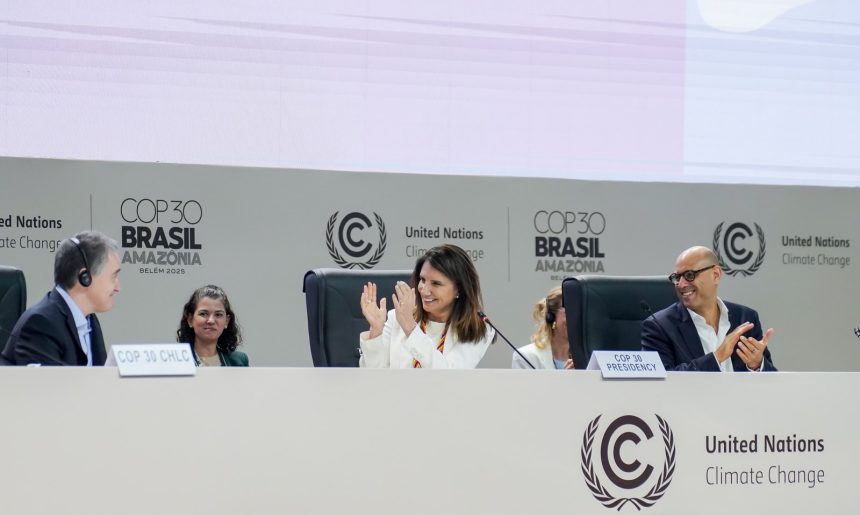
The COP30 Presidency, together with the Climate High-Level Champions, has unveiled a new Five-Year Vision aimed at rapidly advancing real-world climate action and strengthening global cooperation.
The announcement caps two weeks of intensive thematic programming in Belém, Brazil, where governments, financiers, businesses, cities, and civil society converged to push climate efforts into a decisive new phase.
The Vision establishes a coordinated plan to accelerate delivery across the Paris Agreement, building on progress achieved ahead of COP30. It consolidates more than 480 initiatives into 117 “Plans to Accelerate Solutions,” forming the backbone of a redefined Action Agenda focused on implementation, transparency, and impact.
“To accelerate implementation, we need a coalition of the willing,” said Ana Toni, CEO of COP30. “Our countries cannot implement commitments without the private sector, investors, subnational governments and all our societies.”
A New Era of Unified Climate Action
The COP30 Action Agenda represents the most integrated approach yet to implementing global climate goals, combining efforts from national governments and non-state actors under a single framework. Activation Groups—comprising experts spanning energy, forests, food systems, cities, human development and finance—worked throughout the year to identify bottlenecks, align actions and fast-track scalable solutions.
A new COP30 Outcomes Report documents progress across six thematic axes, highlighting strengthened global energy grids, expanded forest finance, scaled regenerative agriculture, enhanced resilience planning, and significant advances in climate-health and adaptation finance.
“What we’ve showcased in Belém is climate action shifting into a new gear,” said Dan Ioschpe, Climate High-Level Champion for COP30. “Cities are decarbonising, businesses are reengineering supply chains, financiers are redirecting trillions, and Indigenous Peoples are driving forest protection.”
Major Commitments Across Six Climate Axes
1. Transitioning Energy, Industry & Transport:
A global coalition committed to a USD 1 trillion investment plan to triple renewable energy by 2030, backed by USD 148 billion per year for grids and storage upgrades.
2. Stewarding Forests, Oceans & Biodiversity:
Governments renewed the COP26 land-tenure pledge with an additional USD 1.5–2 billion, ensuring 20% of climate finance reaches Indigenous Peoples and local communities. Protection measures now cover 160 million hectares.
3. Transforming Agriculture & Food Systems:
More than USD 9 billion has been invested in regenerative agriculture, benefiting 12 million farmers across 110 countries and restoring 210 million hectares of land.
4. Building Resilience for Cities, Infrastructure & Water:
Cities representing 25,000 buildings and USD 400 billion in annual economic activity cut 850,000 tonnes of CO₂ in 2024. New finance platforms aim to reach 200 cities by 2028.
5. Fostering Human & Social Development:
The Belém Health Action Plan—the world’s first climate-health adaptation framework—launched with USD 300 million in philanthropic backing. Race to Resilience initiatives have benefited 437.7 million people.
6. Unleashing Enablers & Accelerators:
Adaptation Finance partners announced USD 1 trillion in investible adaptation pipelines by 2028, with 20% projected from private capital. Multilateral agencies and philanthropies pledged an additional USD 500 million for local capacity building.
Building Momentum Beyond Belém
The Five-Year Vision is designed to maintain global momentum by aligning climate action with scientific guidance, financial flows and a whole-of-society approach. The revamped Global Climate Action Agenda framework strengthens continuity and ensures progress is measurable and transparent.
“We’ve seen what happens when every part of society steps forward,” said Nigar Arpadarai, Climate High-Level Champion for COP29. “The Five-Year Vision keeps us focused and accountable—accelerating progress everywhere, for everyone.”
With the COP30 platform demonstrating unprecedented cooperation among governments, investors, Indigenous Peoples and civic groups, Belém signals the beginning of a new era defined by implementation rather than negotiation. The refined Action Agenda, shaped by a decade of groundwork, now sets the pace for decisive global climate action in the years ahead.