



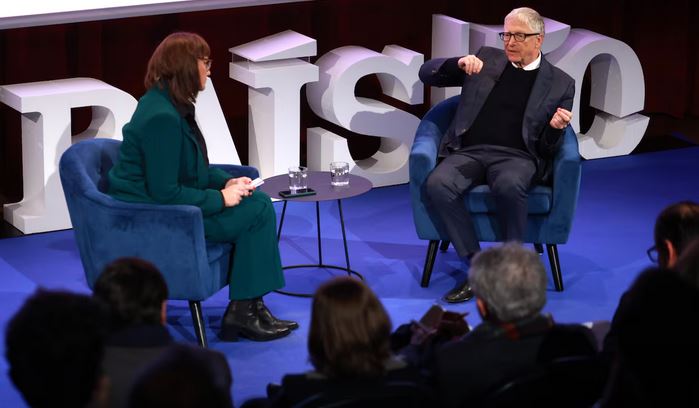
“The miracle that occurred between 2000 and 2025, when child mortality was cut in half, is now going into reverse,” Bill Gates warned on Monday in Madrid.
Speaking in a conversation with EL PAÍS to mark the newspaper’s 50th anniversary, the Microsoft co-founder and philanthropist reflected on a world in which protracted wars, humanitarian emergencies, climate change and weakening international commitments are threatening to undo gains once thought irreversible.
“I don’t think the rule that we must help those who need help has changed, but it has been undermined,” Gates said, calling for the formation of a broad coalition.
The event, hosted by EL PAÍS editor-in-chief Jan Martínez Ahrens, drew nearly 400 attendees, including subscribers, journalists and leaders from Spain’s aid and cooperation sector.
Gates’ appearance came at a pivotal moment for the Gates Foundation, which he founded with Melinda French Gates and which plans to deploy all of its resources, including most of his personal fortune estimated at around $200 billion, by 2045, the year it intends to close.
“I am determined that ‘he died rich’ will not be one of the things people say about me,” he said, arguing against the idea of a perpetual foundation. He added that concentrating spending now would have greater impact and that new philanthropists would emerge in the future.
Moderated by Ana Carbajosa, director of Planeta Futuro, the discussion focused heavily on the crisis in international cooperation. Gates said recent aid cuts in the United States had been “very abrupt,” citing the failure to deliver malaria nets and nutritional supplements.
He recalled how, during the first months of Donald Trump’s second term, budget-cutting efforts led to the cancellation of a program mistakenly thought to support Gaza, but which in fact funded sexual and reproductive health services in Mozambique’s Gaza province, including HIV prevention for pregnant women.
While Spain was described as “swimming against the current” in its defense of global health and multilateralism, Gates noted that even the most generous donors devote less than 1% of their budgets to foreign aid. He stressed that the debate was not abstract, but about funding vaccines, nutrition for new mothers and life-saving medicines.
Asked why wealthy nations should spend abroad amid domestic pressures, Gates argued that maintaining even a small share of budgets for aid was justified, adding that preventing a future pandemic alone would outweigh the costs.
He also expressed optimism about the potential of artificial intelligence to transform health care, education and agriculture if made widely accessible.
“Having doctors we can talk to 24 hours a day about our physical and mental health” or the ability for “the poorest farmers in Africa” to consult their phones about what fertilizer to add to their land will change the world “in a very positive way.”
Despite the adverse context, Gates said he was optimistic. “I’m excited about the various tools we have to help” countries with fewer resources, such as Lenacapavir, an injectable antiretroviral given twice a year with near-100% effectiveness in preventing HIV, or programs aimed at drastically reducing the mosquitoes that transmit malaria.
Despite current setbacks, Gates said long-term trends remained encouraging, pointing to the dramatic reduction in extreme poverty over recent decades.
His “mindset,” he said, is “very positive.” He recalled that in the 1960s, 70% of the population lived in poor countries, and now 70% live in middle-income countries, while only 15% live in very poor countries. “Even countries that were poor are now self-sufficient,” such as India, Indonesia, and Vietnam.
He ended on a hopeful note about the future of work and learning in the age of AI, emphasizing that while technology will change how people learn, motivation and purpose will remain central.
Source: EL PAÍS