



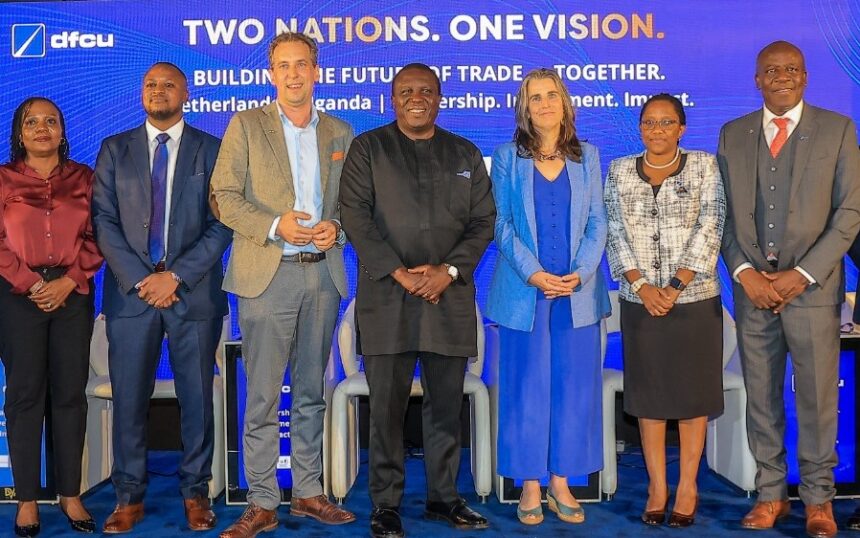
dfcu Bank has hosted business leaders, diplomats and financiers in Kampala to explore new opportunities to expand trade and investment between Uganda and Netherlands, as the two countries seek to deepen cooperation in agriculture and cross-border commerce.
The engagement, organised with the Netherlands–Uganda Trade and Investment Platform (NUTIP), brought together representatives from the Embassy of the Kingdom of the Netherlands in Uganda, Dutch financial giant Rabobank and several private sector players.
Held at the bank’s head office in Nakasero under the theme “Building the Future of Trade, Together,” the dialogue focused on strengthening practical partnerships that can drive investment and unlock export opportunities.
Trade between the two countries has grown steadily over the years. Uganda exports goods worth about $184 million annually to the Netherlands, while imports from the European nation total roughly $289 million.
Beyond bilateral trade, the Netherlands plays a strategic role as a major European logistics and distribution hub, providing Ugandan exporters with access to wider European Union markets.
Agriculture remains central to Uganda’s economic outlook. The sector contributes about 24 percent to GDP, employs more than 65 percent of the population and accounts for a large share of export earnings. For policymakers and financiers, improving agricultural productivity, strengthening value chains and expanding export-ready agribusinesses is increasingly seen as key to sustaining growth.
Kate Kiiza, Executive Director and Chief Corporate and Institutional Banking Officer at dfcu, said the Netherlands offers a powerful example of how agricultural innovation can transform an economy.
Despite its relatively small size, the Netherlands has become the world’s second-largest exporter of agricultural products, a success Kiiza attributed to long-term planning, technology adoption and coordinated investment across the sector.
She noted that Uganda’s own ambitions to modernise farming and boost value addition will depend on partnerships that combine capital, technology, expertise and reliable access to global markets.
Through collaborations with Dutch institutions such as Rabobank and FMO – Dutch Entrepreneurial Development Bank, dfcu has supported agricultural financing and knowledge transfer in Uganda. Initiatives including the Best Farmers programme have helped improve farm management practices and governance within agribusiness enterprises, enabling many farmers to scale operations and strengthen export readiness.
Corrine Abbas, First Secretary for Economic Cooperation at the Dutch Embassy, said FMO currently holds an investment portfolio of more than $205 million in Uganda, spanning financial services, renewable energy and agriculture.
She said the embassy is working with financial institutions and partners to expand access to finance across the agricultural value chain, particularly for smallholder farmers seeking to transition into commercially viable enterprises.
The discussions also featured a macroeconomic outlook from Bank of Uganda, which projected inflation to remain within the mid-single-digit range in the medium term, supporting investor confidence.
Participants concluded that with stronger financial structures and deeper partnerships, the Uganda–Netherlands trade corridor could unlock new growth across agriculture, manufacturing and regional commerce.