



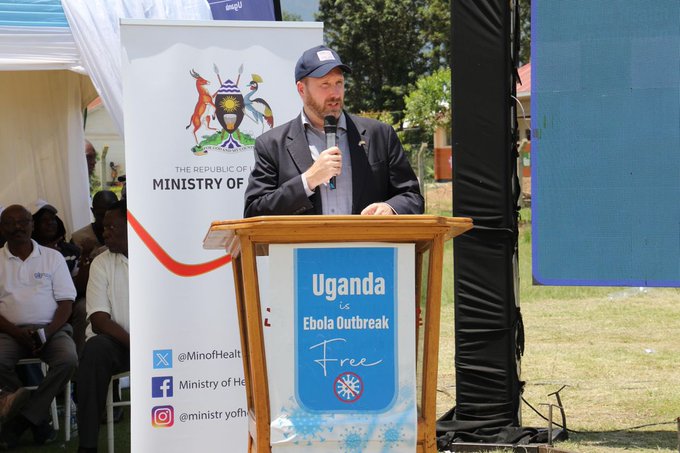
Uganda has officially declared an end to the 2025 Ebola Virus Disease (EVD) outbreak, marking a major public health victory lauded by international partners, including the United States.
In a speech delivered during the declaration ceremony, U.S. Ambassador to Uganda William W. Popp praised the resilience of the Ugandan people and the strength of global cooperation in bringing the deadly outbreak to a close.
“This is a significant milestone in global health,” Ambassador Popp said. “It’s a testament to the dedication of the Ugandan Ministry of Health, frontline health workers, and communities across the country. The United States is proud to have played a role in this success story.”
The United States contributed nearly $8 million (approximately UGX 29.3 billion) to Uganda’s Ebola response, providing technical support, emergency resources, and deploying around 75 public health experts from key agencies including the Centers for Disease Control and Prevention (CDC), the U.S. Agency for International Development (USAID), and the Department of Defense.
These teams worked alongside Ugandan professionals to conduct contact tracing, epidemiological investigations, and deliver training and medical support.
Ambassador Popp highlighted the role of CDC-trained field epidemiologists who helped identify and quarantine hundreds of potential Ebola contacts, a critical step in halting transmission.
He also praised the use of cutting-edge American medical innovation, such as MBP-134 monoclonal antibody treatments, which offered hope to critically ill patients.
In addition to direct health interventions, the U.S. supported extensive community outreach campaigns that reached over eight million people in local languages. Volunteers, including faith leaders, were mobilized to strengthen public trust and ensure a culturally sensitive response.
Looking ahead, the ambassador announced that the U.S. Department of Health and Human Services will donate 500 Rapid Detection Test kits to Uganda in the coming days to bolster surveillance and prevent future outbreaks.
He also commended Uganda’s laboratories for their advancements in diagnostic speed and serology, which he said were achieved through long-term U.S.-Uganda cooperation.
“This partnership matters not only for Uganda but also for the American people,” Popp emphasized. “By acting early and supporting capable partners like Uganda, we’re helping to make both our countries—and the world—safer from future health threats.”
The declaration of the outbreak’s end comes after months of coordinated effort, with Uganda’s Ministry of Health leading the charge. Health officials, communicators, drivers, cleaners, and countless others were acknowledged for their dedication.
“As we close this chapter, we do so with gratitude and renewed commitment,” Ambassador Popp concluded. “Our continued cooperation will build a healthier, safer, and more prosperous future for Ugandans, Americans, and the global community.”