



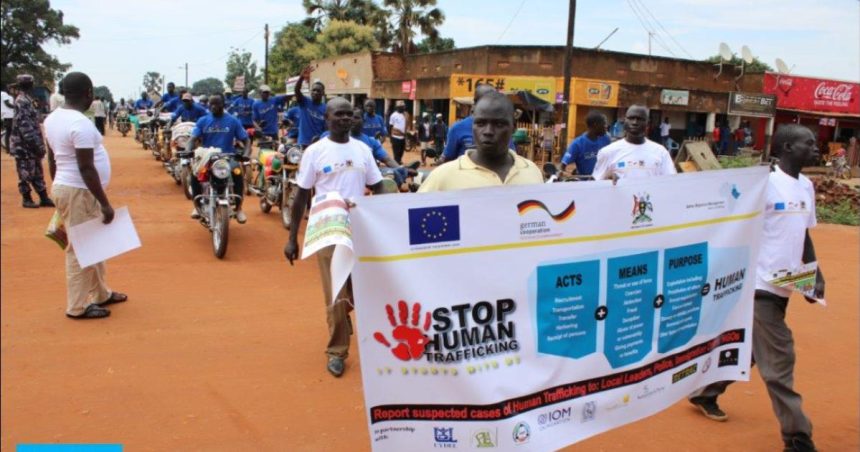
After nearly a decade of dedicated work to strengthen Uganda’s fight against human trafficking, the Better Migration Management (BMM) Programme—implemented by GIZ and its partners—has officially concluded, marking a major milestone in the country’s anti-trafficking efforts.
Launched nine years ago, the programme has supported Uganda through a comprehensive approach based on prevention, protection, and prosecution. Over its implementation period, the BMM Programme achieved significant results: 105 child victims of trafficking were rescued and brought to safety, 35 million people were sensitised on the dangers of irregular migration, and 14 community-driven social action projects were launched across the country.
More than 3,100 law enforcement officers, prosecutors, and other stakeholders were trained to investigate and prosecute trafficking and migrant smuggling cases in line with international standards. In addition, eight key national migration policies, strategies, and legal frameworks—including those aligned with the UNTOC Protocols—were supported, developed, or revised.
“These are not just numbers, but milestones of progress,” said Emmanuel Asiku, BMM Coordinator in Uganda. “Behind the statistics are countless stories of survivors rebuilding their lives, communities taking action, and institutions better equipped to protect.”
The programme’s official closing event, held in Kampala, was attended by representatives from the European Union, the Federal Republic of Germany, and Uganda’s key implementing partners, who commended the transformative impact of the initiative.
Among the most enduring outcomes of BMM is the development and rollout of Standard Operating Procedures (SOPs) for investigating and prosecuting human trafficking cases—a reform credited with dramatically improving Uganda’s conviction rates.
“Before the development of the SOPs, our conviction rate was around 70%. Now, at the International Crimes Division, it is close to 98%,” revealed Joseph Kyomuhendo from the Office of the Director of Public Prosecutions (ODPP), one of the programme’s key partners.
Kyomuhendo noted that the success of these frameworks has inspired confidence in government institutions to invest more in anti-trafficking work. “We now have proof that these models work.
Government is more likely to invest, and we are working with coalitions like the Human Trafficking Institute to ensure continued funding and support. We shall build on this work to end human trafficking.”
As the BMM Programme phases out, Ugandan partners remain optimistic about sustaining its gains. With stronger laws, enhanced coordination mechanisms, and trained personnel across sectors, Uganda is now better positioned to respond to evolving migration challenges.
The conclusion of the programme, stakeholders emphasized, is not the end of the journey but a transition into a new phase of nationally driven ownership and continuity.
“BMM has opened our eyes,” Kyomuhendo reflected. “Uganda now has the tools, the laws, and the people needed to carry this work forward.”
The Better Migration Management Programme was funded by the European Union and the German Federal Ministry for Economic Cooperation and Development (BMZ), and implemented by GIZ in partnership with several international and national stakeholders across East Africa and the Horn of Africa.