



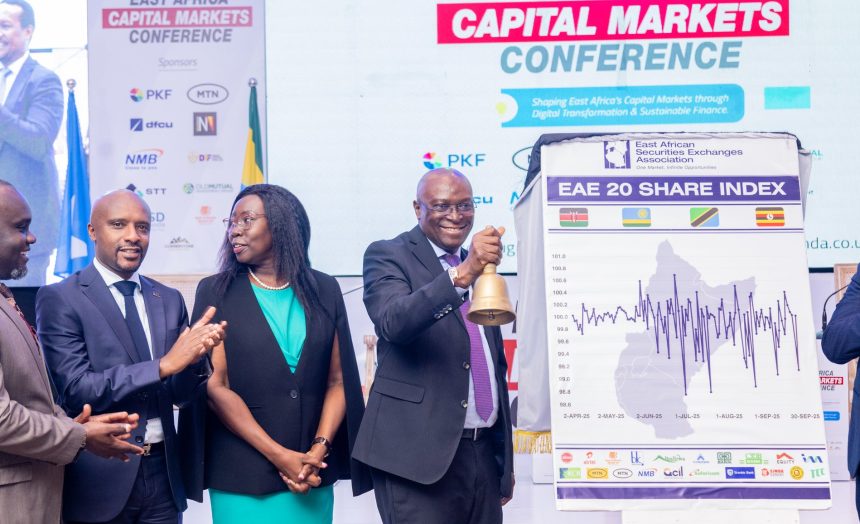
Uganda’s capital markets are entering a defining phase — one anchored in innovation, integration, and sustainability.
The East Africa Capital Markets Conference 2025, held at the Sheraton Kampala Hotel, brought together regulators, investors, and policymakers from across the region to explore how digital transformation and sustainable finance can propel the region’s markets toward long-term growth.
This year’s theme — “Shaping East Africa’s Capital Markets through Digital Transformation & Sustainable Finance” — was was a challenge, a call to action, and a reminder that the future does not wait for the hesitant. Opportunity, the speakers emphasized, belongs to those who dare to innovate.
“Across East Africa, we are witnessing a remarkable transformation. Technology is redefining markets. Investors expect more transparency, more accessibility, more speed. And sustainability is no longer optional; it is a responsibility. These forces compel us to rethink how we operate, how we serve, and how we lead,” remarked Mr. Samuel Mwogeza, Board Director at the Uganda Securities Exchange (USE).
A Landmark for Regional Integration
The conference marked a major milestone with the launch of the EAE 20 Share Index, a regional benchmark designed to track the performance of the top 20 listed companies across East Africa. The new index aims to improve market visibility, foster cross-border investment, and enhance investor confidence across the region’s financial markets.
Representing the Minister of Finance, Planning and Economic Development, Commissioner Moses Ogwapus emphasized Uganda’s immense investment potential, pointing out that the country’s ambition to grow its GDP from USD 53.9 billion to USD 500 billion by 2040 hinges on mobilizing domestic capital and directing it toward long-term productive investments.
“Uganda’s capital markets provide many investment opportunities because the country needs to structurally transform the economy to a GDP of USD 500 billion by 2040,” Ogwapus said. He added that under the upcoming National Development Plan IV, Uganda is prioritizing the financial sector as a key enabler of sustainable and inclusive growth.
Innovation and Inclusion: The CMA’s Bold Vision
For Mrs. Josephine Okui Ossiya, Chief Executive Officer of the Capital Markets Authority (CMA), innovation is not an accessory but a necessity. She highlighted the achievements of the Deal Flow Facility, a partnership between CMA Uganda, FSD Uganda, and the European Union, which has matched 52 companies with potential investors — unlocking deals worth over USD 30 million, with four companies already closing USD 6.1 million in funding.
She emphasized the need to make investing simple, fast, and inclusive. “Technology is not a side project but the core enabler of market growth; investing should be as simple as sending a mobile money text. Through the CMA Regulatory Sandbox, we are creating space to test new products, advanced analytics, and smarter investor–capital linkages under adaptive regulation,” she added.
Her message was direct — East Africa must move from conversation to collaboration, and from potential to performance.
Rethinking Savings, Investment, and Risk
Patrick Ayota, Managing Director of the National Social Security Fund (NSSF), emphasized the importance of building trust, convenience, and empowerment for savers and investors.
“Our market is big, but a lot of potential remains untapped. What people need is safety, convenience, and empowerment,” Ayota said. “The U.S. created incentives that made people want to save such as tax benefits — yet here, before you even save with NSSF, your money is taxed.”
He also urged policymakers and market players to think creatively about infrastructure financing, proposing the tokenization of the Kampala–Jinja Expressway as one example of how to attract private investment into national development projects.
“The goal is not to copy but to customize global innovations to suit our market. Infrastructure, like highways, is becoming a new way of accessing capital beyond traditional financing methods,” he explained.
Ayota drew historical parallels to remind participants that even the world’s leading markets began with humble beginnings and perseverance.
“In May 1772, 24 traders in New York City came together and signed the Buttonwood Agreement. They only had three government bonds and two bank stocks in 1792. Today, more than 200 years later, the New York Stock Exchange (NYSE) has listed over 2,100 companies with a capitalization of USD 32 trillion,” Ayota said.
“Similarly, in 1698, a gentleman called John Castaing started selling stocks in coffee houses in London to willing buyers and sellers. Necessity made these people come for coffee because Castaing was publishing coffee and stock prices. Today, the London Stock Exchange (LSE) has more than 1,300 companies listed, boasting over 4.5 trillion British pounds in capitalization. These were humble beginnings, but with resilience and commitment, they built thriving markets. We need to think about the struggles the NYSE and LSE went through to make their exchanges work.”
Building Confidence and Expanding the Investor Base
Adding to the conversation, Mr. Samuel Mwogeza noted that East Africa’s perception of risk remains one of the biggest barriers to deeper market participation.
“Our perception of risk as East Africans is very different from that of non–East Africans. We do, however, have a big market, but the potential is untapped. We need to know how to tap into this market. We need to convince East Africans to invest in this market,” he said.
Mwogeza also referred to insights from USE CEO Paul Bwiso, who revealed that Uganda’s local investor base has grown from 38,000 in 2020 to over 270,000 today — a sign of growing confidence and participation.
“NSSF has over 2.2 million people saving with us, so I hope he wasn’t counting us as a single investor,” Mwogeza joked, adding that more needs to be done to bring individuals, SMEs, and cooperatives into the investment ecosystem.
Capital Markets as the Engine of National Transformation
Mr. Saul Sseremba, Board Chairperson of the Capital Markets Authority Uganda, described Uganda’s capital markets as the future engine of inclusive, long-term economic growth.
“Our goal is clear: to make Uganda’s capital markets the engine room of long-term, inclusive economic growth,” Sseremba said. “We must leverage instruments such as green bonds, shariah-compliant finance, private equity, and the securitization of infrastructure projects to unlock the trillions of shillings required for national transformation.”
He added that integration and collaboration across the East African region are no longer optional but essential. “Integration is imperative; our regional response must be one of agility, collaboration, and technological innovation. After all, capital markets are not just about finance; they are about the future.”
From the early coffee houses of London to the bustling trading floors of New York, history teaches that great markets are built through vision, courage, and endurance.
As Uganda and East Africa push forward, their challenge is not to replicate the past, but to reimagine the future — one where technology, trust, and innovation drive shared prosperity across the continent.