



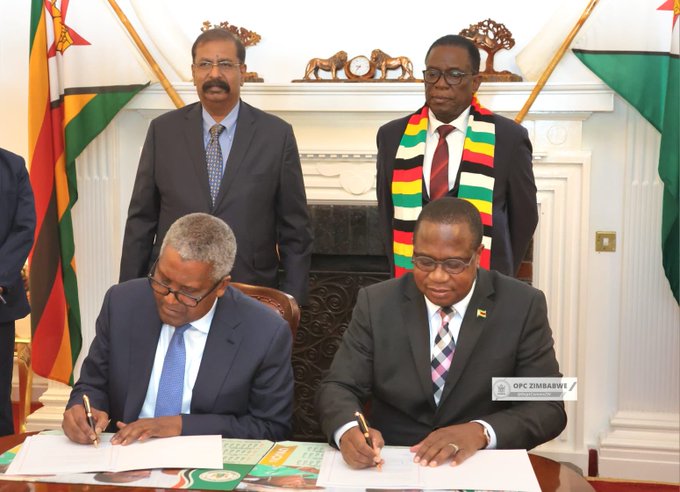
African industrialist Aliko Dangote has announced plans to construct a strategic fuel pipeline from Namibia’s Walvis Bay to Zimbabwe, in a move expected to significantly transform fuel transportation across Southern Africa.
The Nigerian billionaire revealed the development after meeting Zimbabwean President Emmerson Mnangagwa in Harare on Wednesday, where both sides discussed wide-ranging investment opportunities.
The proposed pipeline aims to streamline the movement of fuel from the Namibian coast into Zimbabwe and potentially further into the region’s interior.
Dangote said the project would reduce transport bottlenecks, cut long-term logistics costs, and support energy stability not only for Zimbabwe but for neighbouring landlocked markets that rely heavily on cross-border road haulage.
President Mnangagwa confirmed that Zimbabwe and the Dangote Group have signed a broad investment framework covering energy, cement, fertiliser, and infrastructure development—sectors central to Zimbabwe’s Vision 2030 economic transformation agenda.
He described the engagement as a “historic opportunity” to position Zimbabwe as a regional logistics and industrial hub.
The fuel pipeline, once completed, is expected to complement Walvis Bay’s growing role as an entry point for regional trade, offering an alternative to congested routes through South Africa and Mozambique.
Economic analysts say the project could enhance energy security for Zimbabwe, improve supply chain efficiency, and spur new industrial activity along the route.
For Dangote Group, which has an established footprint in cement and is expanding aggressively into petrochemicals and refining, the Southern African investment aligns with its strategy to integrate energy infrastructure across the continent.
The partnership also reflects the rising confidence of African investors in African economies—championing intra-continental capital flows at a time when global financing conditions remain tight.
If realised, the Walvis Bay–Zimbabwe pipeline could become one of the region’s most significant energy infrastructure projects in the coming decade.